Tuesday, February 16, 2010

Ottolenghi


Ottolenghi , 287 Upper Street, Islington is the sort of place where I would like to be able to eat much more often. ‘Fine dining’  and 'molecular gastronomy' have their place I suppose but I prefer not to get dressed up to eat out and don’t feel comfortable in the environment many restaurants perpetuate with staff who give the impression that they are lowering their standards by having to serve you. Ottolenghi specialises in simple dining.
It looks simple - the space is long and narrow and white with one communal table running the length of the room. The decoration is the food itself – front shelves piled with cakes and gorgeous billowy meringues, a table covered with bowls of salads (fabulous contrasts of colours), and boxes of groceries destined for the kitchen. The menu is a simple in form – an A4 page of the day’s choices (when I asked for a souvenir copy one was quickly run off the printer for me) – and in process – the price is set and depends on the combination of dishes you choose. On the day I am there for lunch the menu lists 11 salads and six ‘main courses’. The idea is to order as much as you think you can eat – either a choice of three or four of the salads (£9.30/£11.80), or, a combination of two or three of the salads and one of the ‘main courses’(£12.30/£14.30).
The food itself is deceptively simple. This is the sort of effortless food that results from careful experimentation with the balancing of flavours and textures and relies on the best fresh, seasonal produce.
For example salads such as
  • roasted beetroot with poached quince, red endive, basil, red onion, sherry vinegar and pistachio
  • roasted butternut squash with red pepper, pine nuts, basil and gorgonzola sauce
  • spicy char-grilled broccoli with chilli and garlic
  • roasted cauliflower with saffron, capers, sultana, red onion, green olives, parsley and lime
  • white and yellow Iranian rice with barberry, cumin seeds, dill, almonds and pistachios

can be teamed with main courses such as

  •  char-grilled organic salmon with seaweed, braised leek, red onion, chilli and mixed herbs salsa
  •  lamb and pistachio kebab with parsley, spring onion, chilli and butter yoghurt
 or

  •  roasted corn-fed chicken with dried figs, honey saffron, onion and basil

Little wonder then that the place is popular. When we arrived on a Saturday afternoon there was a queue at the door, standing perhaps a little too close to the food on display, and we waited 20 minutes to be seated.(It isn’t necessary to eat in Islington to enjoy the Ottolenghi experience because all the food can be purchased to take home and there are branches in Notting Hill, Kensington and Belgravia. And if all else fails there is Ottolenghi, The Cookbook.)

 Eating here was really the highlight of our few days in London and this style of dining – the environment and the menu – seemed like such a perfect fit with the Sydney climate and lifestyle that it seems ridiculous we had to go so far for the experience.

Thursday, January 28, 2010

Books for Cooks


One of my favourite book shops is Books for Cooks in Melbourne . Here they have an excellent selection of current titles and a huge and diverse collection of second hand books. Tim knows his stock backwards, the staff are cheerful and helpful and altogether it is a great place to browse and potter about – very hard to visit without purchasing something.
The London Books for Cooks  was a little disappointing by comparison – a tiny space which for some reason seemed much more intimidating. And there were no second hand books! What the Notting Hill establishment does have however is a programme of workshops (held upstairs) and a miniscule café at the back of the shop. The café is their ‘test kitchen’ where the recipes from the books they sell are prepared by one of their resident chefs and then tried out on the clientele. On the day we were visiting there was a rush for the tables at lunch time – first in best fed, although the eaters appeared rather too sophisticated to actually push one another out of the way.
The combination of books and food isn’t the novelty that it used to be and the idea that shop which specialises in books about food should actually also sell food seems so obvious that it’s incredible it doesn’t happen everywhere. And indeed it does happen even here in Sydney – the Book Kitchen in Surry Hills  for one.
What was so appealing about the Books for Cooks approach was that they were using recipes from the books they had on the shelves. If you really enjoyed your slice of Hugh Fearnley-Whittingstall’s Chocolate and Chestnut cake you might just feel inclined to purchase The River Cottage Year. Alternatively you could always take home a copy of Books for Cooks 9 the latest collection of the most popular recipes from the test kitchen which would also introduce you to recipes by Maggie Beer, Bill Granger and Greg and Lucy Malouf – perhaps not so surprising since almost all the Books for Cooks cooks are from either Australia or New Zealand.
Surely the best way to evaluate any recipe book is to cook from it. Unfortunately the average purchaser has no access to sampling before they buy. Doesn’t the potential buyer want to know whether the recipes actually work? Perhaps not. These days so many books are more photograph than recipe any way perhaps it doesn’t matter how well the recipes are written or how well they have been tested. Since it is unlikely that the average celebrity chef who is travelling the world opening restaurants and attending book signings has written all or indeed any of the recipes which appear in their books we can only assume that someone somewhere is doing the hard yards.
Which brings me to one of my perennial gripes – why don’t newspaper and magazine reviews do justice to recipe books? All too often the ‘review’ is a mere paragraph of publicity blurb rather than a thorough evaluation.
 
The illustration at the top of this post is a post card of an original oil painting by Selina Snow.

Sunday, January 10, 2010

Neal's Yard Dairy - Cheese Heaven

There must be people who don’t like cheese. People who would find the idea of visiting a shop where the counter and shelves are piled high with rounds of cheese unexciting, even unpleasant. Such people do not swoon at the rich and pungent aroma, do not beg to be given even the tiniest taste. They are to be pitied.
If you are ever in London and need to visit a little bit of cheese heaven you must make a pilgrimage to Neal’s Yard Dairy.


Here you are not only welcome to browse but encouraged to sample and talk about their cheeses – from something like 70 cheese makers in Britain and Ireland and from Italy and France, made from the milk of cows, sheep, goats and buffalo – the choice is overwhelming. And the staff are unfailingly friendly and knowledgeable.


My favourite was the Stitchelton
a gorgeous soft, buttery blue with a rich complex flavour, produced on the Welbeck Estate in Nottinghamshire using organic, unpasteurised cows milk.  It was divine especially teamed with the most fabulous Eccles cakes I have ever eaten which we also bought at Neal's Yard.

If you don’t know about Eccles cakes – rich currant filling wrapped in flaky/puff pastry and dusted with sugar -you should try them. Named after the town of Eccles (now part of Greater Manchester) where they originated, there is a good, authentic recipe at The Cook and the Chef.

Now that we are back home my latest favourite cheese is a simple guy called Tom from Bruny Island - available at the Eveleigh Carriage Works markets in Sydney.

Monday, January 4, 2010

Holiday Shopping

Although travel is suppose to broaden the mind, in this modern age when most of the world comes to you via one means or another, there is very little about the world outside Australia that comes as a real surprise once you get there. That said I still think travel should be compulsory – if only to get things into some sort of perspective and reaffirm that Australia is perhaps the best place on earth to live even if it is much too far from everywhere else (which is of course half the reason why it is such a wonderful place to be).

Watching all those English chefs on television and reading their books could seduce you into thinking that we were missing out on something here in the Antipodes but you would be wrong. I had naively let myself think that somehow shopping in Sainsburys or Waitrose or Marks and Spencer might just be that little bit more exciting than being in Coles or Woolworths. It isn’t. A supermarket is a supermarket is a supermarket. OK there are a few different products to look at – many more home brand, ready prepared bits and pieces – and the Waitrose magazine Food Illustrated is a much better production and far more interesting than any house magazine you might find at the checkout here but that is about it. The supermarket shopping experience is impersonal and sterile almost by definition.

The best places to shop, and my favourite holiday attractions, are always fresh food markets – where ever they may be.

And in London the most exciting place to spend a Saturday morning is the Borough Market in the shadow of Southwark Cathedral. Not only is the produce here wonderful (fresh and diverse), the market appears to be very professionally run – there’s a map to guide you around (who’s where and when they are open) and a quarterly magazine called Market Life which introduces the stall holders and what they have available. This is perhaps as it should be for a market which can trace its origins back 2,000 years or so and has been operating on its present site for over 250 years.  The market is administered by a Trust, a charity administered by the Board of Trustees, whose mandate is to hold a market for the benefit of the community - now there's a novel idea.


Everything available on the Saturday we were there looked so tempting! From fresh fruit and vegetables, to fish, shellfish, Bresse chickens, rabbits and game birds, pies, pastries and the most seductive cheeses! I could shop here every week!


Monday, December 28, 2009

Dear Mr Slater


Dear Mr Slater,
Your latest book Tender Volume 1 was on my Christmas present list and I have spent the last couple of unexpectedly wet days reading and making lists of what I am going to grow and what I am going to cook.
We have been in our house for four months now and the garden is still a wasteland. Like you we live in an inner  city Victorian terrace - akin to living in a tunnel. If you stand at the front window you get a clear line of sight through to the end of the garden. We do however have access to the rear lane through the garage so all the messy bits, the manure and the mulch, will not have to be carried through the house.

Once the layout is complete - pathways and garden beds - we will have two major growing areas each about 12 metres long running the length of the garden which is only 5.4 metres wide at the widest point. Cramming all the fruit, vegetables and ornamental plants I would like to grow into this space will be something of a challenge.
The garden faces north west and so most of the area gets sun for the whole day. Although it has rained steadily in the few days since Christmas and our water tanks are full, providing sufficient water to keep the garden lush and productive may yet be our biggest hurdle - it is highly unlikely that we will ever see the garden covered in snow. Foxes are not a problem in our part of Sydney, we are however prepared to be troubled by possums who have a fierce reputation for finding the tastiest morsels in any garden - grow something they fancy and they will find it. Late in the afternoon just at dusk we also often see fruit bats flying over so perhaps they too will find our new garden a temptation.
Already there are some plants in the ground - rosemary (a house warming gift from friends who already have a well established vegetable garden), lemon balm, thyme and rhubarb crowns which I have been keeping alive in pots for months while  the renovations to the house were being completed and we were moving from one temporary home to the next. Also in pots are lemon thyme, marjoram, sage and tarragon all waiting for their permanent home.
Reading about other gardens always makes me lament those plants our climate mitigates against such as apples, quinces, rasperries, and I can only hope for success with gooseberries and elderberries (what joy to be able to make elder flower cordial). On the other hand citrus and olives  and passionfruit should present few problems. For advice on what to grow and when to plant here in Australia my reference is Stephanie Alexander's The Kitchen Garden Companion. In the right position Stephanie promises as many as 30 aubergines per bush per season - all your wonderful eggplant recipes will be put to good use.
If all goes well we will be planting in late February in time for broad beans and beetroot and chervil and spinach and masses of salad greens. Like you I have always been something of a gardener with a few herbs and vegetables grown in various gardens over the years but this is our first attempt to establish a garden which is largely edible and organic as well as a pleasant place to relax. I hope we are well on our way to establishing our own little oasis on this side of the globe by the time Tender Volume 2 is available.
Thank you for your books - I have many of them on the shelves. They are always very seductive - beautifully written and presented -and endlessly inspirational.

Friday, November 6, 2009

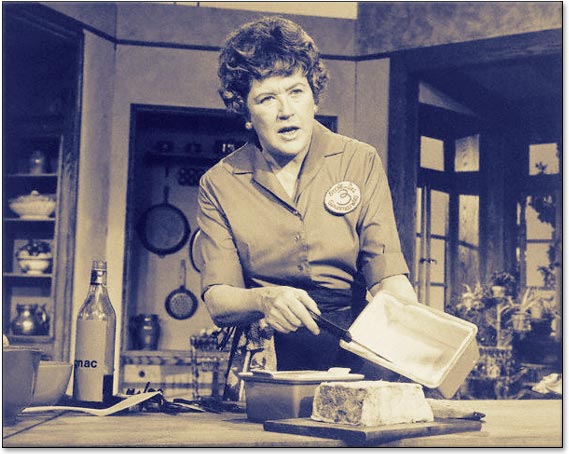
Julia Child and thoughts on the demise of cooking


Most of the last month was devoted to Julia Child. I started off reading the special edition of Gastronomica devoted to Julia (Summer, 2005). This was my real  introduction to Mrs Child  and I was immediately charmed by her no-nonsense approach, her sense of humour and the wonderful relationship she had with her husband Paul. The magazine also includes some terrific photographs. I found her passion and enthusiasm and the obvious pleasure she gained from her devotion to good food both compelling and invigorating..

From there it was off to the movies to see what sort of a job Meryl Streep would do with this character. You probably don’t need to be a foodie to enjoy the film Julie and Julia but it certainly helps. I found it very satisfactory although I would have loved a bit more of Julia’s relationship with her husband and I could have taken a lot more of the gorgeous costumes.

From the cinema it was a very short walk to the bookshop but I have since been pondering how many others would be inspired to go home and actually cook some of the food they had seen on the screen. Nora Ephron, the director, is justifiably proud of the way the food looked in the film and it seems many people may have come away  feeling hungry but simply being interested in food and eating food are not the same thing as preparing food.

Of course I am not the only person in the universe who is pondering the paradox between the number of recipe books available, the number of food programmes on television and the decline in home cooking. Michael Pollan makes a much better job of presenting this conundrum that I could ever hope to do ('Out of the Kitchen, Onto the Couch' ). So how many people will sit down and take time to read what Julia Child took such care to write for us in Mastering the Art of French Cooking? ( Regina Schrambling suggests not many ). And this is a book which needs to be read – it is dense with information and light on pretty pictures in contrast to many of the more recent books on the shelves which are full of gorgeous, lavish photography (usually not just of food ) but seem to be a bit light on substance. Michael Pollan would argue that in fact most people who buy these books are more interested in the pictures than the recipes, more interested in eating food than cooking. This would seem to be borne out by the recent demise of Gourmet magazine. Yes it was a bit elitist but at least there was an attempt in a popular magazine to offer more than just recipes and advertising. Isn’t it more than a little ironic that in Julia Child’s new recognition is based on an internet blog? The internet is now where most people find their recipes. (This article makes interesting reading on the shift away from magazines and Gourmet in particular.)
Thanks principally to television, food consumers are now well educated about ingredients and terminology which makes for confident ordering in restaurants and engaging conversations about esoteric ingredients but doesn’t seem to translate to getting their hands dirty. Michael Pollan suggests that there is no longer a sense that food preparation is a ‘gratifying, even ennobling sort of work’ or that there can be any satisfaction or pleasure to be gained from something as mundane as feeding ourselves. Cooking on television tends to emphasise quick results. Pollan argues our relationship to cooking has become voyeuristic – we enjoy watching people cook because we enjoy eating food not because we want to cook the food ourselves and that our relationship to watching food preparation on television is much like our relationship to watching sport. Not surprisingly there is an inverse relationship between obesity and the amount of time spent on preparing food.

Pollan also raises the serious issues of what our fast world, what loosing a culture of every day cooking is doing/will do to our civilisation if cooking really is the activity which distinguishes us from the animals. (Similarly Jamie Horwitz ('Eating on the Edge' in Gastornomica, Summer 2009) contemplates the changes in where when and with whom we eat.)

Like Carlo Petrini, the champion of Slow Food as the antidote for the fast life, Michael Pollan would argue that the best food is the food you prepare yourself from fresh ingredients. Not only our own personal health but the health of our society and of the planet (think environmental degradation, soil contamination, water usage, loss of biodiversity caused by modern farming practises) could all be improved if we simply spent more time preparing food at home.

But like most problems offering a solution is one thing actually making it happen is something else. Which puts me in mind of Stephanie Alexander and her Kitchen Garden Foundation. She promotes the idea of children being encouraged to learn about growing their own food but emphasises that the process is not complete until the children actually take the ingredients to the kitchen, prepare a meal and then sit down and share the food they have made.

Julia Child and Mastering the Art of French Cooking may not be to everybody’s taste. Perhaps it doesn’t matter if the audience doesn’t go away and cook any of her recipes. But doesn’t the film also carry the message that there is satisfaction to be gained in challenging ourselves and following through on those challenges? Wouldn’t it be good if just a few people went home from the cinema and decided to cook just one or two more meals a week and share them with their family and friends?


Sunday, October 25, 2009

Waste not - Compost!


Whilst progress on the garden per se is slow to the point of being non-existent we have at least commissioned the compost bin. Over the months of moving from one temporary address to another we have been without a compost facility and therefore very aware of the quantity of fruit and vegetable scraps we have been consigning to the garbage bin. Our enthusiasm to get started was spurred both by recent articles in the newspaper about waste and by hearing Stephanie Alexander speak about her passion for growing her own fruit and vegies.
Discussions around the dinner table with friends last weekend convinced me that we are composters and not worm farmers. Worms appear to need care and attention, more animal husbandry, altogether more of a commitment. Compost on the other hand seems to require only the ability to collect suitable material and a degree of patience.
Apparently there are however things that can go wrong. Rats and other nocturnal marauders find compost irresistible so there needs to be some way of ensuring that creatures cannot gain access to the bin if you don’t want to encourage them. Balance also seems to be important – too many orange peels was a bit of a disaster I remember when we tried composting the remains of children’s school lunches – but I have discovered a simple formula for layering the bin. Thanks to Stephanie’s Kitchen Garden Companion I am layering green waste (all the peelings and trimmings from the kitchen plus anything else from the garden) with an equal amount of dry material – in our case leaves and shredded paper – all helped along with a cup full of blood and bone.
In the past we have accumulated the kitchen scraps in a bucket or some other container in the kitchen which hasn’t been especially successful – the contents attract vinegar flies and the container takes up valuable floor or bench space. Thanks to my friend Jan we have now implemented another method. Each day the scraps go into a bag in the freezer. The freezer is then emptied at the weekend and the frozen lumps go into the bin with the shredded paper and the blood and bone. Not only does this keep the kitchen clear of debris but the freezing actually starts the breakdown process and it is easier to keep a track of the ratio of green to dry material – not that I have ever been very rigorous about this in the past.
No doubt there is room for refinement but at least the compost has begun!
And I also have to thank Stephanie Alexander for finding Giovanna Garzoni who is responsible for the wonderful painting at the top of this post.