Tuesday, June 21, 2011

Eliza Acton and Modern Cookery

Everyone (well everyone that is who writes an introduction to one of the editions of Modern Cookery*) agrees on the bare bones of Eliza Acton's life. She was born in 1799 and her father was a brewer. At 17 or so she opened a school for girls which ran for a few years and then she went to France. By 1826 she was back in England and a book of her poems was published. Other poems and articles subsequently appeared in newspapers but when she approached her publishers, Longmans, to print another volume of poetry (some time in the late 1830s) they sent her away suggesting that she might prefer to write a cookery book.


Was the publisher serious or was this his idea of a cruel joke? “My dear Miss Acton, you have as much chance of getting these poems published as you do of writing a cookery book!” Or was he in the same entrepreneurial mould as Sam Beeton? “My dear Miss Acton, don't waste your talents on minor poetry. The future lies in the kitchen. If you want to make us both rich go forth and produce receipts.' Did he just want to be rid of her or did she already have a reputation as a bit of a foodie? Had he been to dinner at the Acton's and realised there was potential here? Did they discuss her future over lunch and did Eliza give him her views on the present state of English food? Why suggest to Eliza Acton, a spinster in her late 30s with literary pretensions, that she go away and write a recipe book? Sad to say we may never know, but in 1845 she was back on the door step with the manuscript of Modern Cookery for Private Families and the rest is history. The book was still in print in 1914, having run to forty editions (the last was 1908) and sold 60,000 copies.

So what was so modern about Modern Cookery?
Acton is concerned with with addressing a modern audience, hers is perhaps the first cookery book written specifically for an urban middle class. The full title Modern Cookery for Private Families makes it clear that her work is concerned with domestic cookery in the private home, not with professional cooks or haute cuisine. She dedicates Modern Cookery to 'the young housekeepers of England'. Were they servants employed as housekeepers or middle class women much like herself who were running their own household with limited means and few staff; women who may have been able to employ maids but probably didn't run to a full-time cook; who aspired to gentility but were also having to devote time to the management of their own homes in the absence of a professional housekeeper.

In her preface she makes her intentions very clear
It is a popular error to imagine that what is called good cookery is adapted only to the establishments of the wealthy, and that it is beyond the reach of those who are not affluent. On the contrary, it matters comparatively little whether some dishes, amidst an abundant variety, be prepared in their perfection or not; but it is of the utmost consequence that the food which is served at the more simply supplied tables of the middle classes should all be well and skilfully prepared ** (1855)
She aims to present 'thoroughly explicit and minute instructions ' which may be 'readily comprehended and carried out by any class of learners'. She did not expect her readers to have had much if any previous cooking experience.

To achieve her goals she employed two very modern approaches. She 'trusted nothing to others' and tested every receipt herself and she introduced the novel feature of a 'summary appended to the receipts, of the different ingredients which they contain, with the exact proportion of each, and the precise time required to dress the whole'. Hers is the first recipe book to suggest that cooking might be reduced to a rational and almost scientific discipline. It is these innovations, her personal comments and observations and her precise and practical approach, which really single Acton out as the first truly modern cookery writer.

For the twenty first century reader it is the mix of the modern, ideas and recipes which still sound modern to our ears, with the quaint and old fashioned which makes Acton particularly interesting. Although her audience was becoming increasingly urbanised and able to purchase a wide range of ingredients she still writes for cooks who will have access to their own supplies of seasonal fruit and vegetables – she goes into great detail about the making of jams for instance and the likely variations in crops from year to year and her recipe for 'Birthday Syllabub' calls for a large bowl containing sugar, lemon juice, port wine, sherry and brandy to be placed directly under the cow 'and milk it full'. At the same time she is familiar with the work of 'Baron Leibeg' and the latest thinking on the nutritional value of foodstuffs. She is more cosmopolitan than her predecessors including recipes for curries and even recommending the use of ready made 'currie- paste' (preferably Captain White's), alongside exotic dishes such as 'The King of Oude's omlet' and 'Risotto à la Milanaise,' In the preface to the original 1845 edition of Modern Cookery she notes that although 'until within very recent years [English] cookery has remained far inferior to that of countries much less advanced in civilisation … we have ceased to be too bigoted, or too proud to profit by the superior information and experience of others upon any subject of utility.'. All the same there is a preponderance of traditional, often stodgy, recipes, for example nine different ways of preparing a calf's head. However modern some of the tastes roasting is still done on a spit, the oven is addressed as something of a novelty and although 'a goose, a leg of pork and a suckling pig, if properly attended to while in the oven, are said to be nearly, or quite as good as if roasted' baking is only really considered an option if you have no other choice. Along with a Bottle Jack for roasting meat Acton's well equipped kitchen requires 'two or three mortars in varying sizes', hair sieves and well tinned copped pans. Cooking was labour intensive and time consuming.

The preface to the 1855 edition of Modern Cookery begins with a familiar, modern lament
It cannot be denied that an improved system of practical domestic cookery, and a better knowledge of its first principles, are still much needed in this country; where, from ignorance, or from mismanagement in their preparation, the daily waste of excellent provisions almost exceeds belief'
and her disdain for style over substance also has a modern ring to it,
Merely to please the eye by such fanciful and elaborate decorations as distinguish many modern dinners, or to flatter the palate by the production of new and enticing dainties, ought not to be the principal aim...of any work on cookery.
Her detailed instructions on how to 'broil' beef steaks (only season with pepper but never salt, heat the grid iron, turn the steaks 'but once') and how to make marmalade, and her recipes for very many dishes such as Christmas Pudding and 'English Sauce for Salad' can be followed just as easily, and with excellent results, today as they could be in 1845. That said however the need to translate the original recipes into modern measurements and cooking times and temperatures perhaps makes Modern Cookery less appealing today than it was originally (although the Quadrille edition does come with a conversion chart). A close reading of Acton only confirms that whilst the present day modern cook has access to a bewildering range of ingredients and kitchen equipment may have changed significantly basic techniques of course have not. It is equally clear that her attention to detail has ensured that her recipes have provided the foundation for subsequent generations of cookery writers.

Acton writes with authority and conviction, in the same vein as say Elizabeth David or Stephanie Alexander, and, like them, with the knowledge that can only come from personal experience and observation in the kitchen. She assures her reader that all her recipes, 'with a few trifling exceptions which are scrupulously specified', can be 'perfectly depended on, from having been proved beneath our own roof and under our own personal inspection' and the detail provided in her observations would suggest that she may have actually put on her apron and rolled up her sleeves to do the cooking herself. It is her confidant voice, her enthusiasm and her somewhat convoluted prose which makes this book such a pleasure to read. Every page yields some little gem of wisdom or insight into the Victorian kitchen such as

  • potato flour 'can at present be procured at most foreign warehouses and general grocers'; but we would recommend its being home-made'
  • 'Genuine amateurs seldom take prepared sauce or gravy with their steaks, as they consider the natural juices of the meat sufficient'
  • 'the quantity of onion, eschalot, or garlic used for a currrie should be regulated by the taste of the persons for whom it is prepared; the very large proportions of them which are acceptable to some eaters, preventing others altogether from partaking of the dish'
  • 'Fruit steamed in bottles is now vended and consumed in very large quantities in this country, but it is not wholesome, as it produces often...violent derangement of the system.'
  • 'No attempt should be made to braise a joint in any vessel which is not very nearly of its own size'
  • and her advice on beating egg whites 'it is a mistake to suppose that they cannot be too long beaten, as after they are brought to a state of perfect firmness they are injured by a continuation of the whisking'
Where did her recipes come from? She tells us that the 'toil' of writing Modern Cookery was 'so completely at variance with all the previous habits of my life' which suggests she may not have had much first hand experience of cooking. Her mother had taken in boarders from the Tonbridge School so perhaps some like that for 'Bordyke Veal Cake' (named after their residence in Tonbridge) and 'Acton Gingerbread' originated in the family kitchen. She makes clear that some s are the 'Author's original recipe'. Eliza had travelled to France so perhaps some of her knowledge of French and even of German and Italian cooking was acquired then. Perhaps she had a reputation for keeping a good table and a good cook in her kitchen who did much of the experimenting (Although given her attitude too plagiarism, the 'unscrupulous' appropriation of 'large portions' of her work 'without the slightest acknowledgement', she would undoubtedly have given credit where it was due if this was the case.). She was the eldest of five children so perhaps she swapped recipe ideas with her siblings and other members of her extended family ('Aunt Charlotte's Biscuits' for example). She credits some of her sources such as 'a highly intelligent medical man who has been for twenty years a resident in the Mauritius', 'a friend who had long experience ...in India, 'an American gentleman'. The range of her recipes and the depth of her knowledge, both of techniques and of foreign foods, suggests a lively interest in all aspects of food and its preparation and a broad circle of friends and acquaintances with whom she discussed her work.

Recipe books don't tell us what people actually ate. They give us an idea of what the household might have aspired to eat, what foodstuffs were perhaps generally available but not which dishes actually appeared regularly on the dinner table. Regardless of social status the Victorian dinner was very much hostage to the cook and her skills, enthusiasm and experience. Acton's book is a mixture of nostalgia for the past, traditional plain English fare, up to the minute ideas and exotic specialities. In England, French food or French influenced cooking had been the preserve of the wealthy who could employ foreign chefs. Acton brings 'foreign' food within the realm of the those 'private families' with social pretensions and a regard for fashion. Did the households who still had access to their own cow for fresh milk also experiment with 'A Simple Syrian Pilaw'? Did families sitting down to a boiled calf's head accompany it with 'Curried Macaroni' or with a 'Puree of Tomatas'? The food on the Victorian dinner table had the potential to be appetising and varied although it might only have been the tables of the wealthier more urban families which ran to such variety. The best pasta for example was to be had from Mr Cobbett's of Pall Mall which 'is not a professedly cheap house, but all that he supplies is of excellent quality'. What Modern Cookery does do is give a glimpse into a world on the verge of great changes, a taste of cookery on the brink of what we now call modern.

Isabella Beeton's Book of Household Management may be better known today but given that a fair percentage of Beeton's recipes are lifted straight from Modern Cookery ***, Acton should at least be credited with her contribution to Beeton's success. Elizabeth David asserts that 'it is difficult to find any standard cookery compendium of the latter part of the Victorian era ...which do not include a quantity of Miss Acton's recipes'. Moreover Mrs David considers Miss Acton's volume to be 'the greatest cookery book in our language'.

*Modern Cookery for Private Families,Quadrille, London, 2011 (with an introduction by Jill Norman)
The Best of Eliza Acton, Penguin Books Ltd., Harmondsworth, 1974 (Edited by Elizabeth Ray with an introduction by Elizabeth David)
Penguin have also recently published a selection from Modern Cookery entitled The Elegant Economist (Penguin Books, London, 2011)
A biography of Eliza Acton The Real Mrs Beeton. The Story of Eliza Acton by Sheila Hardy is due to be published by History Press in October 2011.
** She goes on to say 'particularly as it is from these classes that the men principally emanate to whose indefatigable industry, high intelligence, and active genius, we are mainly indebted for our advancement in science, in art, in literature, and in general civilisation' which just goes to show that she wasn't all that modern in her thinking!
*** In The Short Life and Long Times of Mrs Beeton (Harper Perennial, London, 2006) Kathryn Hughes attributes a third of Beeton's soup recipes, a quarter of her fish dishes and 'many other preparations besides' to Eliza Acton.

Thursday, May 26, 2011

Adrian and Tony come to town

Both Adrian Anthony Gill and Anthony Bourdain were in Sydney this month for the Sydney Writer's Festival. Any of  the writers who were in town must have thought they had died and gone to heaven - the weather was perfect, gentle autumn sunshine everyday, the venue (down by the harbour, in the shadow of the Harbour Bridge) is gorgeous and there were huge crowds of people milling around ready to hang on their every word and buy their books. For me the Festival is an opportunity to put a person to the face you've only seen on television or to the voice you've heard on the radio or perhaps just in your head. And there seem to be precious few opportunities to hear interesting people talk about food so I was a presence at several of the  Gill and/or Bourdain sessions.
Adrian was just as eloquent and angry in the flesh as he is in print, although perhaps even more arrogant and uncompromising and dare I say it somewhat rude and ungenerous, both to his interviewers and his audience. I know his raison d'être is to be provocative but constantly playing for the laughs and the boos wears a bit thin after a while. They both appeared relaxed and confident but Adrian seemed more like a clever school boy compared to Bourdain who was suave, urbane, patient and polite. Both of them were however very honest and Gill spoke quite freely about his alcoholism and his dyslexia while Anthony certainly has made no secret of his past.
As is nearly always the case with interviews the interviewer rarely asks the questions you might want to hear answered and you can't help but feel sorry for 'celebrities' who have to come up with some sort of answer never mind how inane the question, however there were one or two exchanges which were at least worth thinking about.

1. One of Gill's criticisms of Britain is that it is a nostalgic country, that there is a general feeling that the best is in the past and therefore that the past has to be preserved. So the modern is just a reworking of what has worked before which is debilitating in contrast to countries like Australia where there is a general sense of optimism and looking outward rather than inward and backward. It struck me that this is exactly the contrast between what say Blumenthal is doing at the Fat Duck, and more particularly his London restaurant Dinner, and Redzepi is doing at Noma. The food that Blumenthal presents is often grounded in some historical precedent, as though it needs some sort of justification, although it uses modern techniques, whereas Redzepi and Adrià don't appear concern themselves with the past at all.
Both Gill and Bourdain think Adrià is a genius but at the same time they were scathing about interminable degustation menus, restaurants serving food which has to be explained and the notion of a landscape on the plate. Would that someone had asked how they reconcile what appear to be opposing views - the menu at elBulli is interminable, many of the dishes need to be explained and the appearance of the food on the plate is highly contrived. The answer I expect lies in the notion that Adrià knows/understands what he is doing whereas lesser mortals don't and are just being pretentious, but I'm not so convinced myself. However I can't claim to have actually eaten at elBulli so herewith an excerpt from Gill's review which appeared in The Sunday Times on September 28, 2008 (which you can access here)
This is just very, very good cooking: intense, and obtusely original, in the sense that it’s not rooted in history or region or culinary orthodoxy or fashion. It certainly isn’t Spanish. It manipulates a worldwide variety of ingredients. We were given 38 courses that came without fuss or fanfare, at intervals dictated by how fast we ate, not how slowly the kitchen could cook. Most of it was eaten with fingers in a mouthful or two. The combinations of flavours and textures and methods are challenging, but never overpowering, and often astonishing. I’m loath to describe the ingredients: they sound comical or disgusting. Food on paper is only ever an approximation of food in the mouth, and it relies on a shared experience, and if you haven’t eaten here, you haven’t had the experience.


2. Both men were asked on more than one occasion to comment on organic food. There was a consensus that the 'movement' was more of a marketing campaign than anything else since 'organic' does  not necessarily have much at all to do with quality but  has everything to to with creating feelings of guilt and promoting a two tier food system. Whilst a general concern about food politics and food policies, about the provenance of our food, should lead to improvements (more options, more variety) for all (food consumers and food producers)  anything which promotes elitism and snobbery ('farm to table' for example is a bit of a nonsense since all food comes from some sort of farm) is antithetical  to good eating.  Bourdain  in particular argued that the chef is not in the business of politics but the business of pleasure, his concern is deliciousness so, for example, he wouldn't use animals which had been mistreated because said animals wouldn't taste good.

3. On the ethics of eating or at least on the ethics of eating meat it appears that the current criterion is whether or not you would be prepared to eat human flesh. Well it goes without saying that Adrian would and Tony seemed to think that it made sense in the right circumstances, given that both of them had to admit that there wasn't much that was edible that they hadn't  already tried at some time. But Gill went on further to suggest that food is all about eating other people, that is their fresh air, their labour, their water, their land and their culture. Is this a profound statement or just more Gill-speak?  He also said that he didn't much care if animals did suffer, reasoning that we should be giving our time and attention to human rights -his example being that most Ghanaian dishwashers are treated far worse than the geese force fed to make foie gras. We should be more concerned about the welfare of people who work in kitchens (and by extension the people who produce our food at all levels) before we started worrying about animals.

4. Both also agreed that eating is less about what we eat and more about who we eat with. Gill makes the point that humans are the only animals who can make eye contact while they eat signifying that we can eat together without being competitive. Which might be true (more Gill-speak?) but humans do use food to demonstrate status - both intellectual, cultural and social - so eating is to some extent competitive albeit on a more sophisticated level that actually snatching the food off someone else's plate.

5. Adrian Gill also had some thought provoking things to say about electronic media. Not surprisingly he remains a staunch advocate of the free press, by which he means printed newspapers.(He does work for Rupert Murdoch.) He spoke particularly about the discipline involved with print, the editing and peer review, the attention to quality which was, in his opinion, not evident in most of the material churned out on the internet (in particular by bloggers whose opinions are worthless  - he called the internet a virtuous circle of self-satisfaction!). More particularly, and this from someone who is regularly in trouble for his caustic comments, he doesn't like the tone of the internet, the indiscriminate anger evident in the anonymous comments people make, going so far as to say that anonymity is offensive to humanity.

So I wouldn't invite A. A. Gill home for dinner (well he wouldn't come anyway because he doesn't go to dinner parties - not since he sent the food back at the last one he was invited to) but he certainly isn't afraid of being controversial and contrary. He might be a bit smug and self-satisfied but you could never call him boring or predictable. The world would certainly be a poorer place if we didn't have people like him to make us think and question, to justify our own stance on food issues and face up to our prejudices, preconceptions and pretensions. Anthony Bourdain on the other hand could come round for dinner anytime, he would be much too polite to refuse the food on offer, but I doubt the conversation would be as lively.

The Food Fighters panel,  Gill and Bourdain 'moderated' by a hapless Tony Bilson (recorded live at the Sydney Town Hall on 19 May) can be accessed here

Wednesday, May 25, 2011

Apple Season

For those of us who live in the suburbs of Sydney, this is what apple season really looks like. (Not a Pink Lady in sight.)


Monday, April 11, 2011

Eating Out - the Wedding Feast at Cana

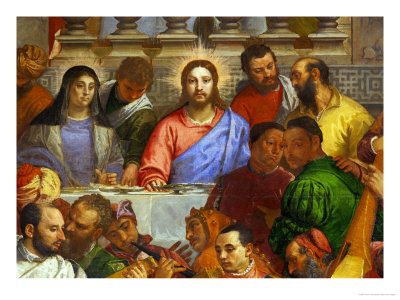
Many a visitor to the Louvre comes away a little disappointed by the Mona Lisa. To my mind she looks a little drab and small for all the attention she is given and these days it is impossible to get anywhere near her because of all the security precautions to say nothing of all the tour groups. If you stand facing her you also miss out on one of the greatest joys of a visit to this museum, a painting that La Gioconda has eternity to contemplate, Veronese's Wedding Feast at Cana.


It is impossible to get a real sense of this painting from reproductions because it is enormous – 6.77 metres high by 9.94 metres wide. Painted in 1562-3, it was originally commissioned by the Benedictine monks of San Giorgio Maggiore in Venice to fill one whole wall at the end of their refectory. Since then the canvas has had a chequered history. It has survived being cut in half and spirited to France by Napoleon, been preserved through numerous European wars and most recently been restored after being damaged whilst hanging in the Louvre. Although the original still resides at the Louvre, thanks to modern technology a facsimile now hangs in the proper location at San Giorgio Maggiore.

Veronese's subject is Christ's first miracle, the turning of water into wine, which was performed at a wedding banquet in the village of Cana. Christ was a guest at the banquet along with his mother and his disciples. When it is apparent that there is no more wine for the guests Jesus instructs the servants to fill containers with water which when tasted has turned into excellent wine. Veronese's version of these events does not depict a simple, rustic feast in a dusty village but a sumptuous Venetian banquet. No doubt the monks contemplating this scene as they ate would have been aware of all sorts of religious symbolism. I am more interested in what this painting can tell us about dining in Renaissance Italy.

First of al I love the colours – the glorious blue of the sky and rich colours used to convey the luxurious fabrics worn by the wedding guests and the officials involved with the feast. The fabulous outfits worn by the bride and groom on the left of the picture, the velvety green of the man on the left (supposedly the governor of Cana, the master of ceremonies) presenting the wine to the groom and the rich brocade of the wine steward on the right examining the wine in his glass.

The sense of luxury attests to the wealth of Venice and the power of its citizens as does the rather eclectic attire of the guests. Powerful family dynasties used marriages to forge strategic political alliances with other courts in Italy and Europe, and welcomed aristocratic visitors and guests from far away and exotic places. Men of status used banquets as a means both to show off and to maintain that status. The celebration of an event such as a wedding was an opportunity to demonstrate hospitality and to communicate wealth and power.
What you served your guest and how you served it also communicated who you were. In this case the table is covered with a crisp, white cloth and laid with expensive looking plate. Everyone appears to have their own place setting including a knife, fork and napkin suggesting not just wealth but also up to the minute fashion, testimony to the host's good taste and sophistication.

Intricately folded table napkins were becoming popular table decorations. Eating with forks was still something of a novelty as was the idea of eating from individual plates rather than sharing from a common dish. The wine is served in delicate glass goblets – with large shallow bowls which maximised the amount of wine exposed to the air – which is also an allusion to the skill of Venetian glass makers. At the top of the staircase on the left of the painting jugs and plates are being taken down from the credenza where they were displayed for all to see. Cold food was prepared on the serving tables adjacent to the credenza.

Although no one seems to be eating much and there doesn't seem to be much food on the tables there is a flurry of activity in the background indicative of the number of people and the amount of effort involved in producing food for a lavish banquet. Food was usually presented as a sequence of hot and cold dishes and a meal might consist of nine or ten courses, each course consisting of several different dishes. Perhaps by not showing food on the table Veronese was avoiding any suggestion of gluttony while creating a table and a setting which would reflect an occasion befitting the attendance of Christ as a guest and also the Benedictine dictum of hospitality.

All the guests seem to be enjoying themselves, chatting to one another (although none of them do appear to be actually talking), taking in what is going on around them and enjoying the musical entrainment. There is a real sense of conviviality.
There are two things which puzzle me about this picture. The first is the woman on the left who is looking down the table at the bride with what looks like a toothpick in her hand.

Bejewelled toothpicks were probably still fashionable at this time, they appear in household inventories which survive in the Archivio do Stato in Venice, although the the practice of wearing them on a chain around the neck may have been considered a little uncouth. However from the examples that survive and the paintings which show them being worn, these toothpicks were curved, talon like whereas whatever Veronese's young woman is using appears to be straight. One suggestion is that she is sucking pensively on a fork.* She is obviously doing something, and something distinctive which sets her apart from the others at the table. Whatever it is Veronese included it deliberately but why? Veronese included lots of little details that his viewers must surely have found acceptable and recognisable - like the number of dogs and cats there are in the scene.


There are only two characters in the painting who look out at the viewer. Amidst all the back and forth in the background and the chatter and activity in the foreground Christ sits in the centre, calm and tranquil, gazing down on the monks as they eat their meal. Clearly not against everyone having a good time Jesus remains aloof from the action around him.

The only other person not entirely involved with the action in the painting is the bride herself. She seems oblivious to what is going on around her – to the earnest man on her left who seems to be talking to her, to her husband on her right, to the pageboy handing up the glass of wine, to all the noise and commotion. What is she thinking? What did Veronese intend we should think of her?


*This is the suggestion of Roy Strong in his Feast. A History of Grand Eating (Jonathan Cape, London, 2002)

The information on toothpicks comes from Nicholas Penny, 'Introduction: toothpicks and green hangings', Renaissance Studies, Vol. 19, no 5, pp. 581-590.

See also Katherine A. McIver 'Banqueting at the Lord's Table in Sixteenth-Century Venice', Gastronomica,Vol. 8, no. 3, pp.8 -11, Valerie Taylor “Banquet plate and Renaissance culture: a day in the life', Renaissance Studies, Vol. 19, No. 5, pp.621 – 633, and Nichola Fletcher, Charlemagne's Tabelcloth, A Piquant History of Feasting (Orion Books, London, 2005).

To see how the painting in its original context and to learn more about the facsimile go to Factum Arte.

Thursday, March 24, 2011

Ode to the Aubergine.


Still life with tomatoes, a bowl of aubergines and onions
Luis Meléndez
oil on canvas, 36.8x49cm
Derek Johns, London
Luis Meléndez is one of my favourite still life artists and so I wanted one of his works to illustrate my Ode to the Aubergine. Unfortunately in this instance he seems to be more interested in the tomato. What does please me about this painting is its simplicity - the plain wooden table, the rustic pottery bowl, the feeling that these vegetables have been plonked down on the kitchen table ready to be sliced up for the next meal - and the way the subject fills the field of vision and focuses your attention.
 Meléndez painted the ordinary things of everyday life, the fruit and vegetables and kitchen objects he would have found in his kitchen at home. Neither the tomato nor the aubergine is native to Europe. Tomatoes were brought back from the New World by Spanish and Portuguese explorers. Unusual both in appearance and taste, and a member of the suspicious nightshade family, the tomato didn't become generally acceptable in gastronomy until the 18th century. Aubergines, also nightshades, originated in India and travelled along earlier trade routes, certainly coming to southern Spain with the Muslim occupation if not before.
 Meléndez painting suggests  that the artist probably liked his food and  knew that aubergines and tomatoes and onions were made for each other, with the implication also that by this time (the 1770s) these ingredients were no longer unusual. Thanks to the way he brings his subject to life, when you look at this painting today you don't just see what Meléndez saw but you can almost taste what he tasted. The stars of the show, the tomatoes, with their wonderful rich colour  and their glorious sheen promise intense flavour while the hoary, prickly calyxes of the aubergines hide their contents suggesting that there might be hidden pleasures inside.The onions are subordinate but  have a significant role both in the structure of the painting and the flavour of the dish to be prepared.
What interests me too is that some 240 years after Meléndez arranged this composition all the ingredients are still immediately recognisable for what they are, albeit that the deeply ridged tomatoes are now what we would call 'heirloom' and the aubergines look small and undernourished compared to the commercial varieties which we are picking from the garden at the moment.
Hence my Ode to the Aubergine.
The plants themselves are lush and robust with big, lobed, slightly downy soft green leaves and small unassuming purple flowers. They have been so easy to grow - seemingly oblivious to any sort of pest or disease (although one or two have succumbed to sunburn) and existing on minimal amounts of rain. Everyday I pick more of the fruit, heavy and tight in their skins, so shiny they look as though they have been polished and a deep purple-black like no other colour.
And we have eaten them in every form you can think of, dishes with exotic names to do justice to the exotic appearance of the fruit - smokey baba ghanoush style dips, parmigiana di melanzane, tian d'aubergines, ratatouille, caponata, imam bayildi, moussaka, melitzanes papoutsakia, baigan pachchadi and the cupboard is stacked with jars of kasaundi. I've fried them, grilled them, baked them, barbecued them; sliced them into rounds, sliced them length ways, cut them into cubes, scooped out the flesh and stuffed them, and still they keep coming. It's tempting to think of the poor aubergine as a cross between Jack's bean stalk and something out of The Sorcerer's Apprentice.
On the other hand when struggling with what to feed the family there is great pleasure in knowing that there is always something in the garden to provide inspiration.
From me the aubergine gets five stars - good to grow, good to look at, good to cook with, good to eat and good to share. My Turkish friend Haluk turns 50 today and his gift will be a bag full of freshly picked aubergines which I know he will appreciate and put to good use.

Wednesday, March 16, 2011

What price milk?


Still life with milk can and apples
Paul Cézanne, oil on canvas. Museum of Modern Art, New York.
The big supermarket chains, Coles and Woolworths, are selling their generic brand fresh full cream milk for $1 per litre. Two questions - how and why?
How can they afford to do this? Well Woolworths admit that they are only reducing their prices to be competitive and that they don't see how they can maintain this level of cost cutting. To date it is the retailers who are bearing the reduction in profit but dairy farmers are justifiably anxious about the long term implications for them if supermarket prices remain this low.
Dairy farming is no picnic since cows produce milk all day everyday and someone has to be around to see that they are milked. The raw milk is then sent off for processing. The processors sell their own brand of milk and also negotiate a price with their customers and competitors - the supermarkets. The dairy farmer is paid by the processor at a rate which clearly depends on the price the processor receives for the pasteurised milk. The processor gets a higher return on his own branded milk than on generic, supermarket brand milk so whilst lowering the price of milk in the supermarket may mean that more milk is sold overall the return to the farmer must eventually be reduced. Coles may well argue that they are not out to hurt the farmers and really only want greater transparency of farm gate pricing but at $1 per litre surely no one makes and money - transportation, refrigeration and packaging alone must eat up most of the price.

Why are Coles cutting the price of milk? Well the answer seems to be 'because they can'. In marketing terms they presumably hope that by cutting the prices on essential items customers will flock to their stores in the belief that Coles only wants what is best for their patrons. Along the way of course the shoppers will buy other items and eventually be so convinced that a Coles supermarket is a consumer paradise they will never want to shop anywhere else.

What alarms me is the power that retailers have to control what we eat - not just what we can afford to buy but what is actually available to us. Whether Coles persist with maintaining this price war or not it is worth pondering what might result if they do. One consequence might be that branded milk disappears from the supermarket altogether. In other words you buy Coles/Woolworths milk or you have to seek out milk from small independent dairies which will inevitably be more expensive. (At the moment it is possible to buy milk from independent processors but at around two and a half times the current price of Coles milk).
The two largest milk processors in Australia - National Foods and Parmalat - are not Australian companies. It probably doesn't matter all that much to them whether Australians have fresh milk in their supermarkets or not. According to Coles 50 percent of our milk production is exported and only 25 percent of total production  is fresh milk, so one consequence might well be that fresh milk disappears from the supermarket altogether and we end up only producing, if not importing, UHT milk. Anyone who has travelled in Europe will know that in many places UHT milk is much more common than fresh, refrigerated milk.

Clearly we can't rely on the moral conscience of the people who run the supermarket chains to make long term decisions about our food supply.Who has the authority to stop Coles and/or Woolworths doing whatever they want? As consumers one approach would be to boycott Coles and Woolworths and only buy branded milk.  At least this strategy would mean that the dairy farmers would continue to get a reasonable return for their product. This is easy for me to say because I can afford to pay for my principles. I don't buy fresh fruit or vegetables or meat from the supermarket and never buy anything that is a house brand but there are plenty of others who do and who welcome a reduction in a family staple with open arms.
Only buying milk from independent, locally owned processors sounds like a good idea but again only for those who can afford it and with the proviso that probably this approach won't be much help the dairy farmers who rely on contracts with the two big processors.
Given the amount of milk my children consume I have often toyed with the idea of taking control of our milk supply and buying a cow of my own but I think there are probably local council regulations which have something to say about grazing cattle in the local park.

What I don't understand is why they, that is the Federal Government, doesn't/can't do something. Isn't that what governments are for? If part of the role of government is to see that everyone has access to an education and to health care don't they also have a responsibility to ensure that everyone has access to a healthy and stable food supply?
CHOICE advocate a National Food Policy (how is it possible that we don't already have one?) in the belief that 'a more centralised approach is needed to ensure the many and varied players along the food supply chain operate in a co-ordinated and strategic manner'. Hear, hear!!!


For CHOICE see here
For Coles and their current marketing strategies see here

Friday, February 25, 2011

How Cornish is the Cornish pasty?


The Cornish pasty has been granted 'Protected Geographical Indication' (PGI) status by the European Commission. What does this mean?
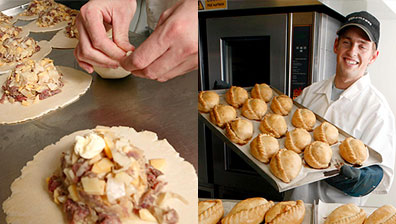
Henceforward a Cornish pasty is a savoury, D-shaped pasty which is filled with beef, vegetables and seasonings. Any sort of pastry can be used provided it is savoury and 'robust enough to retain shape throughout the cooking, cooling and handling process and serves to avoid splitting or cracking.' The pastry is crimped by hand or mechanically 'to one side, and never on top'.
A Cornish pasty must contain not less then 25% vegetables which must be sliced or diced potato, swede/turnip and onion only, not less than 12.5% meat which must be minced or diced beef and seasonings. No other types of meat or vegetables or any artificial additives can be used and all filling ingredients must be uncooked at the time of sealing the product.
And to be called a Cornish pasty the product must be assembled in the designated area of Cornwall.

Now the European Commission don't go around the countryside looking for things to classify, chances are they would never have heard of the Cornish pasty if it hadn't been for the Cornish Pasty Association. And who are they? Well you might not be entirely surprised to learn that they are a group of Cornish pasty makers who just happen to all be in Cornwall and are concerned 'to protect the quality and the reputation of the Cornish pasty and to stop consumers being misled by pasty makers who trade off the value of the name without producing a genuine product.' They believe 'protection of the Cornish pasty is necessary in order to safeguard the heritage of the Cornish pasty, the future of the industry and the reputation of the product.'


Safeguarding traditional foodstuffs and the heritage of their production is all part of the modern nostalgia for the past, a back lash against the commercialisation of food production and the fear that local traditions and even national identities will disappear into the blandness of globalisation. In Cornwall the pasty is historically associated with the mining industry. It was a neat, convenient and economical meal for the labouring man. The crimped edge was held by the miner as he ate and then discarded because contaminated with the grime from his hands. So the pasty is an unashamedly proletarian foodstuff, a reminder of hard times and hard work. Now that the mining industry in Cornwall is no more (although the mining landscape has been granted World Heritage Status) the poor pasty becomes a potent symbol of the 'good old days' albeit one which is commercialised and now standardised.

Will being granted PGI achieve the stated aims of the Cornish Pasty Association? Simply standardising the ingredients is surely no guarantee of the quality of the finished product. To qualify to carry a Cornish pasty logo, proof of authenticity, there is no requirement that the raw ingredients be sourced from within Cornwall, so there is no suggestion, for example, that turnips grown in Cornish soil are essential to the final flavour. Many consumers are unlikely to find a pasty made with puff pastry equal in quality to one made with shortcrust pastry (made with lard of course), and many consumers already consider that a pasty made with mince in highly inferior to one made with diced beef whether made in Cornwall or not. In fact to qualify as Cornish it is only 'the assembly of the pasties in preparation for baking' which must take place in the designated area, the actual baking does not have to be done in Cornwall. So what's Cornish about the Cornish pasty?
 Is it cynical to suggest that the Cornish Pasty Association is less interested in protecting the good name of the pasty and more interested in the future of the industry in Cornwall and ensuring that 'consumers willing to pay a premium price for a genuine article' will make an appropriate contribution to the Cornish economy?

Safeguarding tradition is something that Cornish families have been doing for centuries and Cornish pasties are consumed in countries around the world. Does it matter that some of them may contain carrots and have the crimping on the top rather than at the side? Perhaps it is no bad thing that there is some standardised recipe for a Cornish pasty just so that no one ever gets the idea that pastry stuffed with Tandoori chicken might have originated in Cornwall but to suggest that only pasties which are made to that recipe AND 'assembled' in Cornwall can rightfully be called Cornish pasties seems – well at least odd, if not down right silly.
 
For more on the Cornish pasty and what some people think of the granting of PGI status see here and here
The Cornish Pasty Association are here and you can read their application for PGI status here and click on the link.
The images above are from the Cornish Pasty Association website.