Monday, March 24, 2014

The joys of marketing - discovering the Mlekomat.

Food markets are endlessly fascinating. There's the people


 and what they sell and how they display their wares


 and then every now and again there's a complete surprise, something you've not encountered before. like whole heads of sunflower seeds
or the Mlekomat.


These photos were taken in the market place in Ljubljana but it appears that the Mlekomat is neither a new or particularly unusual sight in Europe. It is just an automatic milk dispenser - you can watch a very cute video of how it works here - but such a good idea.


Friday, March 14, 2014

Abandoned blogs revisited

The universe works in mysterious ways. This morning Eater.com announced the appointment of three full-time restaurant critics (here), one of whom, Robert Sietsema has been somewhat critical of his new masters in the past. In the Columbia Journalism Review he wrote
Eater, a Web site spun off by the real-estate blog Curbed, has become a clearinghouse for professional and amateur reviews, along with restaurant gossip and periodic reports on the progress of coming restaurants. The site legitimatized instantaneous reviews published by bloggers under auspices that were opaque to the reader, giving them equal billing with professional reviews. Whether a meal was eaten for free by a reviewer who'd announced his presence beforehand, or according to principles of professionalism and anonymity, is of no concern to Eater. The site captures the culinary zeitgeist of our era, with its mixture of lively gossip and real-estate reporting.
His article is titled 'Everyone Eats ... but that doesn't make you a restaurant critic' and you might guess he is critical of the amateur reviewer and their lack of ethical standards. (I would guess that he is also critical of the writing style and language non-professionals use. Well it might not be unethical to use 'legitimatized' but surely 'legitimated' would be better?) Presumably now that Eater.com has its own professional critics it will be raised above 'the digital free-for-all'. Going into the professional reviewing business is a big step for a site whose original manifesto was restaurant news and gossip, they now claim to be providing a public service by filling the gap left because traditional print media continues to place less emphasis on traditional reviews - slashing budgets and sacking reviewers.

Sietsema himself was a victim of these cut backs, having been the restaurant critic of The Village Voice, published weekly in New York, until May 2013 when he was sacked and then joined Eater. (You can read more about Sietsema and his career in The New York Times, at Eater.com and at the Huffington Post ).
The idea that Eater.com is becoming mainstream and that digital media is becoming more and more like the traditional media it was meant to replace prompted this piece from Amateur Gourmet which laments the loss of the 'looseness and scruffiness' which made blogs so appealing in the first place. And Adam should know because he has been blogging for 10 years, although there is nothing amateurish about the review he published of his meal at el Bulli back in 2009 which I still think is the best I've read (and believe me, in the interests of research, I've read many).

And both of the above prompted Phil Lees to  post this graphic which only confirms that the Internet is indeed littered with deserted food sites and abandoned food blogs.

Tuesday, March 11, 2014

Deserted sites and abandoned blogs.

Anyone who starts a web site or a blog presumably does so with the intention of persevering. Sadly it seems the enthusiasm eventually wains. Many of the blogs I have been following have been abandoned and usually one assumes for good reason. In some cases a hobby has turned into a job, and very few people who are paid to write want to spend their spare time writing for nothing. In some cases life has just taken over so that there is no time either to research or to write. The blogs I am interested  in cover a wide range of interests including some which concentrate on restaurant reviews. Maintaining these review blogs involves a good amount of time spent eating at a not inconsiderable personal expense so it isn't hard to understand why these enterprises might stall. And if, as in my case, writing is a slow process then writing anything more than one thing at a time is pretty much impossible, so that any other writing commitments mean that blogging has to take a back seat. Anyway that's my excuse.

And of course many people have just moved on to some other means of communication - Twitter or Instagram or both, or are so busy keeping up with these and maintaining a presence on Facebook and Snapchatting that writing any more than a few sentences is out of the question. Whilst it's easy enough to understand why people move on I wish they would leave some sort of comment on their abandoned blog or web site so that you know what's happened to them. Is it worth checking back from time to time in case they resurface? Have they got a new job, moved somewhere else, given up eating or just become bored and /or lazy? Some sort of final post, even just something along the lines of 'gone fishing', seems only polite if you feel what you have been doing has had any merit or been of interest to your intended audience, whoever they may be.

So, should the day come when this blog ceases, rest assured there will be a post to that effect.

Thursday, June 20, 2013

Cookbooks, the Gastronomer's Bookshelf and John Thorne.

Last month Duncan posted the last entry for the Gastonomer's Bookshelf. The Bookshelf is now an archive of the reviews written since 2008.
As a sometime contributor I sympathised very much with Duncan's aim to give recipe books, and books about food in general, the attention they deserve and 'to give lovers of culinary books access to thoughtful and honest reviews'. In the end it just proved too difficult maintaining a site like this alongside other work commitments. But another stumbling block, even more more difficult to overcome than the need to find more hours in the day, was the difficulty of convincing people to 'review a book on the subject they love'.
I felt a pang of guilt when I read this because I have to admit to finding reviewing recipe books in particular a far more difficult task than I had imagined. My problems arose in part because of the difficulty of establishing suitable criteria and trying to maintain an objective voice. It became more and more obvious to me as I tried to justify my own reactions to certain books and to certain authors that my responses were very subjective and liable to change. For example I have always spoken highly of Nigel Slater and I have several of his books but over time I have modified my enthusiasm. So whilst I still enjoy reading what he has to say I can well understand that others may find it all a bit overblown. I wasn't very impressed with the Alain Ducasse volume I reviewed but several of my friends thought it was both very attractively presented and very useful - who am I to contradict.
But more than anything I started to question the relationship of the cook and the recipe. Why do we need more recipe books? Why when there are so many recipes available on the Internet (and almost everyone I speak to admits to looking up recipes and cooking with their iPad sitting up on the kitchen bench) why is there such an endless stream of new books?
Of course I don't have the answer to these questions but what I would like to share are some notes I took at a conference I attended earlier this year. One of the speakers was Jonathan Milder a research librarian who works for the Food Network in America and he had some interesting points to make about recipe books.

For example, most recipe books don't cite references or have bibliographies or footnotes (with of course some very notable exceptions - Stephanie Alexander, Claudia Roden come immediately to mind) so where does the information they contain come from? Few authors acknowledge the work of others, there is a fundamental ambivalence to the whole question of authorship and plagiarism and unsubstantiated claims (such as 'authentic', 'traditional' and the dreaded 'foolproof') are commonplace.  Milder argued that the absence of critical discourse  on cookbooks was the result of a lack of any secondary materials which would allow for assessment and criticism.

Much of what he had to say he admitted was inspired by John Thorne's introduction to his book Simple Cooking. John Thorne may not be as well known in Australia as perhaps he should be but he is a thoughtful writer and worth seeking out if you are not already familiar with his books.
In Simple Cooking he explains that his 'goal as a cook has always been not so much to attain some specific sense of mystery as to be able to just go into the kitchen, take up what I find there, and make a meal of it' but of course 'an impromptu, impulsive, and ever-adaptive cooking style is not one that the cookbook ...is by nature equipped to explain'.

Paradoxically cookbooks are not good at teaching how to cook. Thorne and Milder argue that the cooking takes place before the recipe, the cookbook cannot step back in time to that moment before the recipe so the book can only offer an act of recreation. To quote Thorne again
'Whether you follow the directions exactly or vary them to your taste, you still can't step back behind them into the sensibility that existed before it did - to that moment in the kitchen when the cook really did not know what she was going to do with all that stuff before her on the table'.

Cookbooks then just recirculate the already known, each new publication  is just the latest articulation; in essence all the recipes are already written, each new version is only an adaptation. All recipes are a product of a people, place and time and the cookbook is essentially an archive of knowledge sourced from non-verbal practise.
Thorne finds it strange that there are hardly any cookbooks which encourage the sharing of  'the muddle and the mistakes and wrong turns - and to consult other cookbooks besides their own - in order to make the experience of cooking a real one. For it is exactly those hesitations, confusions, moments of panic - and then the growing sense of confidence - that shapes the experience of the real cook. The rest is only recipes ... What they offer as experience is very limiting.'

However this does not mean that recipe books don't have an important and necessary place in our cooking lives.What Thorne advocates, and practises, is that cooks should do their own research, read about ingredients and recipes, use their recipe books as resources and interrogate them. What do different authors have to say? What historical details and personal anecdotes do they have to offer?Where do they agree, how do they differ? From this information the cook takes what suits them, - what appeals to your taste and your style of cooking, what fits in with your means and the resources (both equipment and raw materials) available to you. He likens this to a conversation - bringing all these cooks together in your kitchen for a lively debate.

'Juxtaposing all these good cooks provides us with an experience far more valuable than any one of them can offer, because we are suddenly liberated from this nonsensical notion of a seamless cookery. We experience that art as it is and should be: opinionated, argumentative, contradictory, with each cook making the exact same "traditional" dish in his or her own particular way, all the while swearing it is the only conceivable one.'
John Thorne's recipes are the result of his own conversations with different cookbooks.

So perhaps this is why we need another cookbook, why we cut out recipes from magazines and newspapers and why we search the Internet, to add another voice to the conversation. My own kitchen scrap book has for example several pages devoted to variations on baked ricotta, four or five different recipes for versions of eggplant gratin, five or six recipes for variations on lemon syrup cake all with annotations and references to similar recipes in my cookbook collection. What I actually cook is my own creation,

 Felicity Cloake writes a column in The Guardian where she does some of the interrogating for you and thereby adds more voices to the discussion - her article on Lemon Drizzle Cake is here.

Thanks to Wikipedia you can find out more about John Thorne here.
Simple Cooking, John Thorne,Viking Penguin, New York, 1987.

Wednesday, April 10, 2013

Alice (and Gertrude) Again


The trouble with research is that you never know when you are finished. People, places and things that you are interested in keep coming back to haunt you.
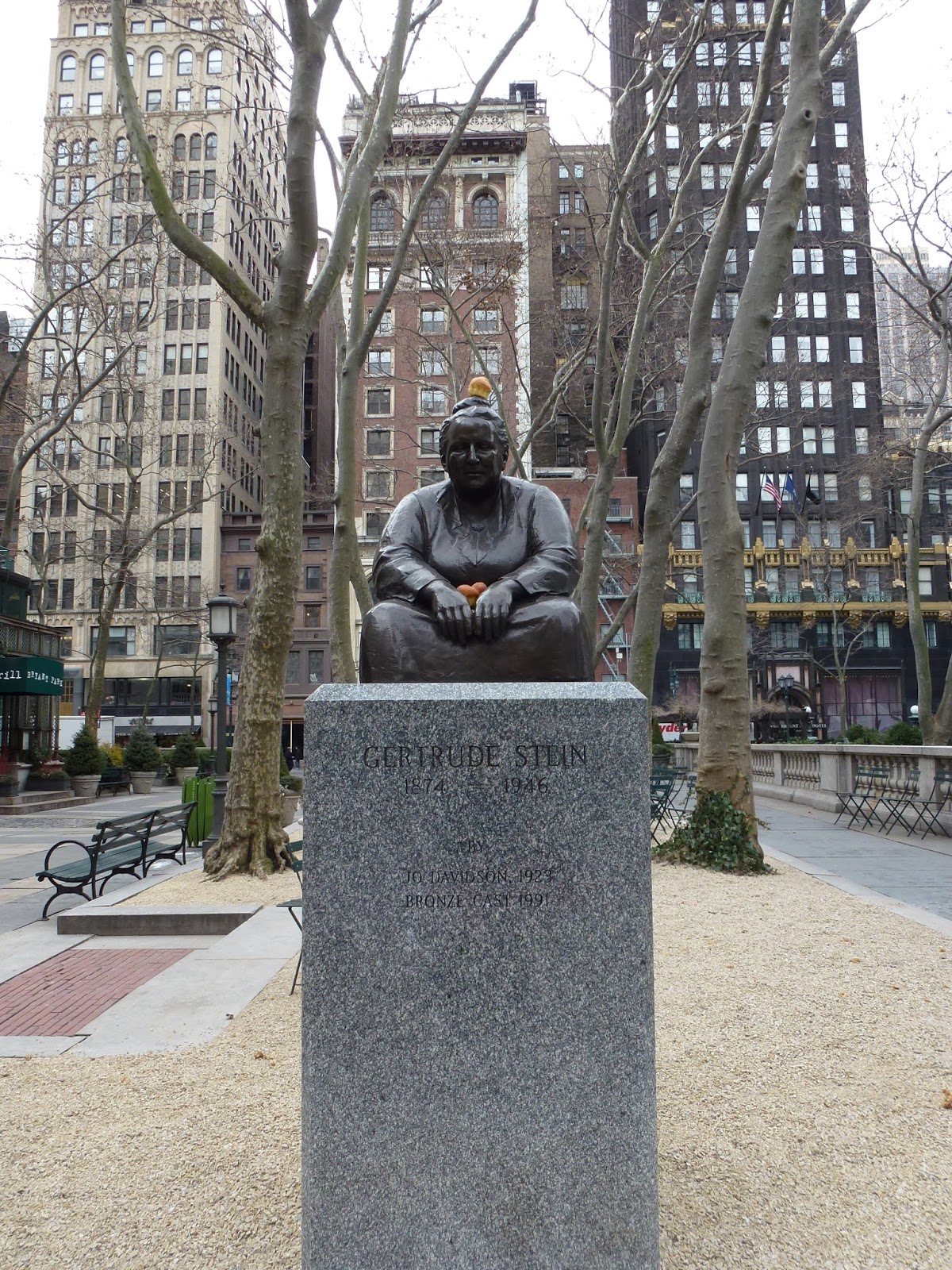
This photograph of the Gertrude Stein statue  in Bryant Park, New York was taken on 7 February. Either someone knows how much she liked her little cakes or they are a gift to celebrate her birthday (on 3 February).
For more information about the statue see the Bryant Park Blog here. Bryant Park itself has an interesting history which you can read about here. I came across Gertrude (well to be truthful I was looking for her) en route to the New York City Library to see the Lunch Hour NYC exhibition (which I have mentioned before and you can read about here) but not before I also encountered Carl Van Vechten's name carved into the sandstone in the library foyer.
So can Alice be far behind? Well since I last wrote about her cookbook I have encountered more information about her too. Deanna Sidney at Lost Past Remembered here introduced me to  Naomi Barry's essay in Remembrance of Things Paris: Sixty Years of Writing from Gourmet. Then reading Laura Shapiro's Something from the Oven. Reinventing Dinner in 1950s America I discovered a whole chapter on Poppy Cannon who collaborated with Alice on Aromas and Flavours of Past and Present. (which I wrote about here). Poppy herself was a wonderful character and I thoroughly recommend Shapiro's thoughtful account of her life and her legacy.
Another recent read was John Thorne's Simple Cooking which includes his review of The Alice B. Toklas Cook Book written on the occasion of the publishing of a new edition by Harper & Row in 1984. In his usual thoughtful way he begins with the problem of the aura which seems to surround everything to do with Stein and Toklas and the warning that unless you approach The A.B.T.C.B. with more than 'a few scattered impressions' about Gertrude and Alice 'you may well begin reading with puzzlement and soon sink into total disgruntlement. Because, while it would be wrong to say that this is a terribly overrated cookbook, it is very much a wrongly reviewed one.' Of the recipes he says  'they do not contrary to the reviews, make you want to rush into the kitchen and try them out' because although a cook book  the pleasure  lies elsewhere,
' to enjoy this book you must find your pleasure in the company of Alice B. Toklas - in a woman who knew exactly who she was. It is this that gives the book its measure of wild charm and also draws its limits, for she was a person of intense domesticity who, having established her realm, felt totally independent within it.
While the gaze she directs at the famous people who grace their table is alert, curious, even sensitive, it is also finally enigmatic, for they have no real impact on her perfect sense of self.'


And of Alice's relationship with Gertrude he says
'There is never one false note in the impeccable ordinariness with which she surrounds that liaison to ever suggest she was ever surprised, frightened, or intoxicated by what happened to her, by the sui generis nature of her life.'
 
 
John Thorne, Simple Cooking, Viking, New York, 1986.
 
Laura Shapiro, Something from the Oven. Reinventing Dinner in 1950s America, Penguin Books, New York, 2004.
 
ed. Ruth Reichl, Remembrance of Things Paris: Sixty Years of Writing from Gourmet, Random House, 2004


Tuesday, January 1, 2013

Afternoon tea with Mrs Lance Rawson


Image from State Library of NSW
 

In The Antipodean Cookery Book and Kitchen Companion (2nd ed., 1897) Mrs Rawson suggests serving 'rolled bread and butter sandwiches made of ham paste, potted ham, tongue or chicken' for afternoon tea. She stipulates that 'the crusts of the bread should be cut off, and the sandwiches cut into three-corner shapes or fingers'. She also notes that salads 'are allowable nowadays' and that 'cakes for the purpose should be very small'. Moreover she gives specific instructions as to the serving of afternoon tea
'For a fashionable afternoon tea the table should be set in the rear of the drawing-room or, if there are two rooms, in the smaller of them. Coloured cloths are usually used, and the table can be decorated with baskets of flowers and fruit. Do not set the plates, etc., round, but let them be placed in piles of threes and fours here and there, with knives, forks and spoons where they can be quickly found when required. A few table-napkins beside them (the smaller the napkins the better.)'
And of course 'the tea equipage should be on a separate table'.

What then are we to make of Mrs. Lance Rawson? She sounds for all the world like a society hostess, very right and proper; and whilst her tone is suggestive of someone who knows how things should be done it gives little clue as to how much she knows about the actual doing. In the preface to her book however she addresses her 'sister housewives' and claims her book has been 'adapted and written expressly to meet the wants and circumstances of those living in the far Bush, as well as those who dwell within reach of the amenities of civilised existence'. And as it happens Mrs Rawson knew a good deal about the wants and circumstances of women living far from the amenities of civilised existence.

In fact Wilhelmina (Mina) Frances Rawson was an extraordinary woman. She was born in Sydney in 1851, her father James Cahill (a solicitor, born in Ireland), her mother Elizabeth (nee Richardson, born in England). In 1857 James Cahill died and her mother remarried in 1863. Mina's step-father was a Scotsman, Dr James John Cadell, who had a medical practise in Raymond Terrace. Mina and her mother moved to Cadell's property near Tamworth where they joined his eleven children by his first wife. As Mina describes it
'When I was barely twelve years of age, my mother took it into her head to marry a man with eleven children. I, being an only and much adored child up to that time, found her ideas of pioneering more tragical than comforting, and as she added four more to the family it is hardly to be wondered that I am somewhat resourceful.' (Queenslander 10 April 1920)
She became a great believer in self reliance adhering to her step father's motto “When you can't do it yourself ask for help, never before!” (Queenslander 12 June 1920)


However 'pioneering' life might have been with the Cadells there was much more in store for Mina. Not yet quite twenty one she married Lancelot Bernard Rawson on 26 June 1872. Lance was probably thought to be a good catch. He was the youngest son of Charles Stansfield Rawson who had been a member of the East India Company and whose ancestral home was Wasdale Hall in the Lake District. It is unclear when Lance came to Australia but around 1867 his two older brothers Charles Collinson Rawson and Edmund Stansfield Rawson, had taken up a property on the Pioneer River near Mackay in Queensland and it was The Hollow that Lance and Mina made their home after their marriage.
 
The Hollow, 1874
(John Oxley Library, State Library of Queensland)
 

Mackay is described as 'an aristocratic corner of Queensland' at the time. The climate was 'congenial' and the Pioneer River provided the settlers there with good transport and shipping connections. At The Hollow Mina joined Winifred and Decima the wives of Lance's brothers who were themselves sisters, the daughters of an English clergyman whom Charles and Edmund had travelled back to England to marry. How Mina fitted in to this arrangement we do not know but life at The Hollow may well have been more sedate than she had been used to. The house was large with a fourteen foot wide verandah all the way around reportedly covered with masses of every sort of creeper. The garden was lush boasting poinciana trees, custard apples,lemons, limes, guavas, grapes, mangoes and oranges, with a fernery off one side of the verandah. The photographs suggest life was comfortable and civilised.
Drawing room at The Hollow
 (photograph by Edmund Rawson ca. 1875, John Oxley Library, State Library of Queensland)
 
Verandah at The Hollow ca. 1875
(photograph by Edmund Rawson, John Oxley Library, State Library of Queensland)
 
The Rawson sister strolling along the garden path at The Hollow in the 1870s
(photograph by Edmund Rawson, John Oxley Library, State Library of Queensland)
 
However in 1877 Lance decided to branch out on his own and take up a partnership in a sugar plantation, Kircubbin, near Maryborough. This was the first of his not so bright ideas. The plantation was not a success and in 1878 Mina published her first recipe book The Queensland Cookery and Poultry Book as a way of bringing in some income. By 1880 the plantation was bankrupt and the Rawsons moved on to Boonooroo in the Wide Bay region, where they were the first European settlers. Their plan was to set up a fishery but this was another disaster.

As Mina describes it Wide Bay was 25 miles by road from Maryborough but in 1881 the only road was a cattle track which was impassable so the only means of transport to Maryborough was the Brisbane steamer which passed once a week, or their own boat, a trip of 80 miles by water. Looking at the map today it is easy to imagine how isolated they were. What's more Mina arrived there in March 1880 with three young children and gave birth to her fourth child that May.

Mina wrote up her memories of her time at Boonooroo in a series of articles which were published in The Queenslander between December 1919 and July 1920. She describes a hard and lonely life – they made everything from soap, salt, candles and bacon made from dugong to beds and mattresses and hammocks which they sold to bring in some money. She fashioned her own furniture, entertained the odd visitor, had some hair raising encounters with the local aborigines, grew what vegetables she could, experimented with cooking bandicoot, flying fox, ibis (fresh meat only came every 12 weeks) and one way or another learnt to make the best of her circumstances. In her spare time she wrote fairy stories which were published in one of the local papers.

They were not without help from friends (who contributed a number of gadgets including sewing machines, washing machines, an American stove, a mincing machine, a churn and not least a patent nutmeg grater) and they were at least in contact with Lance's family who sent them boxes occasionally but life must have been pretty grim. Most of her female visitors fled quite unable to tolerate the conditions and Lance was often away from home. Although she was obviously quite capable of packing up her children and taking herself off on the steamer to either Maryborough or Brisbane Mina stuck it out but nonetheless she hated Lance being away. She claims she came to understand that for her husband 'it was an impossibility for him to stay away from the companionship of other men'.
This is the same Mina Rawson who writes in The Antipodean Cookery Book and Kitchen Companion,
'Man must be cooked for. He'll do without shirt buttons, and he'll do without his slippers, but he will not do without his dinner, nor is he inclined to accept excuses as regards under- or over-done meals after the first week or so of the honeymoon'.
She goes on to warn those contemplating marriage that 'only by feeding him well will you succeed in gaining your husband's respect and keeping his affection'. It would seem however that Mr Rawson had more to admire in his wife than merely her cooking skills.

I could find no photographs of either Mina or Lance. I imagine that Lance was probably rather dashing, a bit of a romantic hero, handsome and charming and able to sweep Mina along with his confidence in his plans. She does let on that he had a bit of a reputation for pranks and 'lighthearted frolics' and that her mother thought 'he must be a great trial to his nice quiet brother'. She certainly has nothing to say against him. Writing in 1920 of her time at Boonooroo she says
'I began to feel that I could not go on living at Boonooroo. But unhappily our circumstance would not permit of our leaving, it being the only home we had, and as a matter of fact I was the only one earning...When I look back at that time I could almost cry at our childish want of practical knowledge. If we had not been young our hearts would have been broken with the repeated disappointments of the place. The only reason we remained was because we were almost self-supporting, and I was able to earn enough to keep us in the necessities we did not produce. It was simply our sense of humour which kept us from dying too.'


Just how long they spent at Boonooroo and how their situation was resolved is unclear but Lance was eventually appointed as a Crown Lands Ranger and sometime around 1886 they moved to 'Rocklands' in Rockhampton. It was here that Mina published her other recipe books, The Australian Enquiry Book in 1894 and The Antipodean Cookery Book and Kitchen Companion in 1895, and became a swimming instructor, reputedly the first swimming teacher in central Queensland.

Lance died in 1899. He was 56 and both of his brothers had returned to England by then, Charles in 1886 and Edmund in 1894. Mina took on the role of social editor of the Rockhampton People's Newspaper for the years 1901-02. In 1903 her circumstances took another turn when she made her way to London to marry Francis Richard Ravenhill. Apparently Ravenhill had been Lance's business partner in the Boonooroo venture (although I couldn't find a reference to him in her newspaper articles) but, if his gift to the bride of of various bits of pearl, emerald and diamond jewellery are anything to go by, he hadn't suffered any great financial hardship as a result.. Mina wore a wedding gown of fawn silk voile, with a toque of brown chiffon and deep crimson roses and carried a bouquet of red rosebuds and lilies of the valley. She had come a long way from the lonely nights writing fairy stories in the bush. And the guests showered them with all sorts of fancy silver gifts, including a silver crumb scoop which was presumably of some use to them in London.

Mina remained in London until 1905 when the Ravenhills decided to travel to Australia. Whether this was planned as a permanent move or not is unclear but they travelled home with Mina's daughter Minnie who had been visiting them. I think they returned for Minnie's wedding which was scheduled for early 1906. In the event Francis Ravenhill died at Galston (outside Sydney) in February 1906.

What Mina did after that I don't know other than that her memoirs were published in the Queenslander as noted above and she died in Sydney in 1933.

On the one hand Mina knew all about polite society. Her brothers in law were well know and well respected gentlemen (Edmund Stansfield was briefly mayor of Mackay); one daughter, Una Belle (Muffet) married Lionel Ottley Wilkinson, nephew of Sir John Ottley*; the other, Minnie, married Ronald Swanwick from a notable Queensland legal family and at the time of her engagement (1906) it was expressly pointed out that Miss Rawson was the second cousin of Sir Harry Rawson the then Governor of NSW. On the other she certainly had her own experience of reduced means and isolation. The fact that she may have had the right sort of connections doesn't detract from the fact she had seen first hand the 'wants and circumstances of those living in the far Bush'. Her books and other writings suggest that she was not afraid of getting her hands dirty, that she was both practical and imaginative and curious enough to learn from those around her (she freely acknowledged that she had learnt all she knew of indigenous foods from the Aboriginal people she had encountered) and adapt her own ideas and standards to fit her situation.
Most historians credit Mina for her use of local ingredients, for example her recipes for stewed ibis, stewed wallaby and instructions on how to prepare pig weed and bandicoot, but I wonder whether these recipes were put to much use by her readers. In dire circumstances curried bandicoot might have to suffice or might serve as a novelty but I suspect it was her knowledge of local conditions rather than her knowledge of local ingredients which was of most use to her audience. Mrs Beeton for example would not have provided information on how to deal with banana stains or how to get rid of ant's nests. The use of whatever was to hand had more to do with ideas of practicality and frugality than any desire to foster thoughts of an Australian cuisine.
And implicit in all Mina's writing is the idea of bringing civilisation to the Bush and the important role that women had to play in this civilising process.  Did Mina have her 'tea equipage' on a separate table when she entertained visitors at Wide Bay? Did she even have a separate table? Whether she did or not she obviously thought it most important that her sister housewives should know the right way to do things and should aspire to maintain their standards regardless of their circumstances.

* It was Mrs E. R. Ottley, Sir John's mother, described as an early settler of Rockhampton, who owned Rocklands Estate. Lionel and Una Belle were married at Rocklands in 1899 but I haven't been able to work out how Mina and Lance came to be living at Rocklands. The Wilkinson family were also associated with Rocklands station, Camooweal.

For more information on the Rawson family and The Hollow see here.
Details of Mina's life were gleaned from the Australian Dictionary of Biography here and from newspaper searches via the Trove web site here. To the best of my knowledge there is no other published biographical information about Mina and Lance. A search of Trove will also yield a number of photographs, paintings and drawings of the Rawson family and life at The Hollow.

Wednesday, December 26, 2012

Trifling Matters, or when is a trifle not a trifle?

 
Is this a Trifle?
Cassata Trifle from www.taste.com.au
Photography Petrina Tinslay. Recipe published in delicious,  May 2006, p. 136. 
 
Christmas morning, that is the morning of 25 December, always sees me putting the finishing touches to a trifle, which involves simply putting the various pre-prepared components together in the right order. And as I do this I think about my mother because I always make a trifle the way she did and I wonder where the whole trifle thing came from.

The historical background has been traced in some depth by Helen Saberi and Alan Davidson ('Whims and Fancies of a Trifle-Lover' by Helen Saberi in The Wilder Shores of Gastronomy, Ten Speed Press, Berkeley 2002 and Trifle by Saberi and Davidson, Prospect Books, 2009). In its present form the trifle has come down to us via the 'fool' which is essentially flavoured cream and the syllabub which is basically cream flavoured with wine and whipped to a froth. The biscuity or cakey base and custard come in to the picture from the mid-eighteenth century.

According to The Oxford Companion to Food the trifle is a 'traditional English sweet or dessert. The essential ingredients are sponge cake soaked in sherry or white wine, rich custard, fruit or jam, and whipped cream, layered in a glass dish in that order.' Jane Grigson in English Food confirms the details of what seems to be the 'traditional' English trifle. Her recipe for 'a pudding worth eating', calls for macaroons, soaked in a mixture of 'Frontignan, Malaga or madeira wine' and brandy, covered with a custard made with cream and eggs and thickened with rice flour. Once the custard is cool and firm it is spread with a layer of raspberry jam. The finishing touch is a layer of syllabub, cream flavoured with, in this case, white wine or sherry, brandy and lemon, whipped up into a froth.

The authors of the OCF go on to say that trifle 'is essentially a popular dish, i.e. a dish of the people, more apt to be present at family celebrations and children's parties than in cookery books or on restaurant menus.'

A search through my cook books certainly confirms that recipes for trifle are likely to be few and far between. It also confirmed that there is some consensus as to what constitutes a traditional trifle.
Both Mrs Beeton and Eliza Acton require a base of sponge cake or sponge biscuits, ratafias and macaroons soaked in sherry or wine and brandy, a rich custard, syllabub and cream. Nothing much has changed by the time we get to my mother's first cookery books, the first edition of Good Housekeeping 's Cookery Book (1948) and Cooking with Elizabeth Craig (1947). Both of these publications call for sponge cake spread with jam soaked with sherry and/or brandy, custard and whipped cream. Elizabeth Craig calls for macaroons and ratafias in the cake layer, Good Housekeeping uses macaroons in the trifle and ratafias for decoration, similarly shredded almonds are a component of both, and the Elizabeth Craig version is decorated with glacé cherries and angelica. Good Housekeeping also has recipes for a Banana Trifle (containing bananas of course and decorated with cherries, angelica and chopped pistachios), Cherry Trifle (with both cherry jam and stewed cherries and made with either sponge cake or cake crumbs) and Pineapple and Ginger Trifle (using tinned pineapple and preserved ginger and custard made from custard powder).

The Good Housekeeping Cookery Book of 1985 uses a Victoria sponge, raspberry jam and macaroons, sherry, custard, cream and flaked almonds and glacé cherries for decoration. The Silver Palate Good Times Cook Book (1985) includes a recipe for 'Old English Trifle' which requires Sara Lee pound cake and raspberry jam, amaretti crumbs, marsala, custard, almond flavoured cream and almonds for decoration.

That there is some discrepancy between what the recipe books would have us believe is 'traditional' and what cooks actually produce in their own kitchens is demonstrated by comments such as Jane Grigson's when she compares her recipe to 'the mean travesty made with yellow, packaged sponge cakes, poor sherry and powdered custards' and derides 'the brassy effect of angelica and glacé cherries'. Similarly Simon Hopkinson and Lindsey Bareham in The Prawn Cocktail Years insist on 'decent' sherry and preferably amaretti or macaroons/ratafias but definitely not 'shop bought' sponge cake. For them 'jelly is an abomination' and fresh fruit too tart and 'somehow alien to the confection'. And that there is on-going debate about what constitutes a real trifle is born out every year by articles such as this one or this one which claim to set down the rules for trifle making.

I don't know where or when my mother learnt to make trifle. She came to Australia from England in her early thirties – did she make trifle before she came here? Surely she must have done. Did her mother use ratafias? Did my mother remove any trace of almonds from her trifle because she didn't like the flavour, because my father didn't or because I didn't? Certainly a trifle was part of most celebrations. I can't remember a time when it was not an integral part of Christmas. I also can't remember a trifle that didn't involve shop bought jam sponge roll – preferably the little rollettes. The cake layer was flavoured with sweet sherry in the early days but became more sophisticated when Mum started using Marsala – did she learn this from Robert Carrier and his Great Dishes of the World? (Somewhere along the way we also discovered that Marsala was terrific poured over vanilla ice cream).

In our trifle the next layer is always canned fruit, two fruits to be exact. Did my mother discover two fruits (that is a mix of diced peaches and pears) before she came to Australia? Was this considered some sort of delicacy in post war Sunderland? I doubt that she would have encountered two fruits in her mother's kitchen in Little Eaton.

On top of the two fruits, abomination of abominations, comes a layer of Port Wine jelly. The jelly is set separately and then broken up with a fork and spread over the fruit so that it forms a discreet layer and doesn't soak in to the cake – now that would be an abomination! Other flavours of jelly are acceptable but not quite right. I don't remember that she made packet jelly at any other time or for any other purpose. I do remember that my mother was quite capable of making her own aspic and jellied beetroot so using a commercial packet jelly was a conscious decision. Was it too hard to get the right flavour starting from scratch?

Then comes the custard. My mother always made the custard using custard powder. Again it wasn't that she didn't know how to do it any other way. She made sensational egg custard tarts and custardy puddings but runny custard was always made with custard powder. Trifle custard was always made with custard powder, slightly more than recommended on the packet so that it was very thick. Once set the custard was broken up with a fork before spreading over the jelly and for special occasions whipped cream was mixed through. I always make custard for trifle with custard powder.

The final layer is whipped cream. In the past my mother decorated her trifle with 'brassy' cherries and angelica. We thought it was ambrosia. The only real variation I have made is to eliminate both the cherries (because not everyone likes them) and the angelica (because it has become increasingly hard to buy, and anyway angelica on its own would be a bit silly).

How my mother came to this final pinnacle of perfection I will never know but I make trifle the way she did. That is the way my family like it, that is the way our extended family like it. I am the reigning family Trifle Queen and this is the trifle I make every Christmas. I make no excuses for its rather plebeian ingredients. A trifle is not to be trifled with – other layered desserts are trifles in name only. I think a trifle should, as the name suggests, be something light or trivial, it shouldn't take hours to prepare and cost a fortune to make. But made with care the end result is so much more than the sum of the individual components. A mere trifle becomes something special to share to celebrate the moment and commemorate the past.
 
Note: Cassata Trifle is not a trifle if only because it is made with savoiardi not sponge cake, and contains fresh raspberries and ricotta. Anything with chocolate, even if only grated over for decoration, is not a trifle. 'Cassata' and 'trifle' are two words which do not belong in the same sentence let alone the same title.