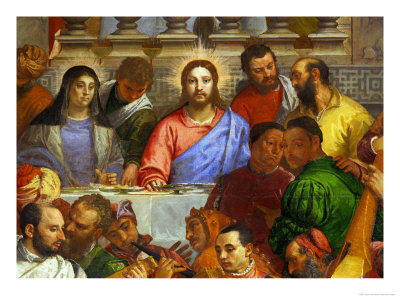
Many a visitor to the Louvre comes away a little disappointed by the Mona Lisa. To my mind she looks a little drab and small for all the attention she is given and these days it is impossible to get anywhere near her because of all the security precautions to say nothing of all the tour groups. If you stand facing her you also miss out on one of the greatest joys of a visit to this museum, a painting that La Gioconda has eternity to contemplate, Veronese's Wedding Feast at Cana.
It is impossible to get a real sense of this painting from reproductions because it is enormous – 6.77 metres high by 9.94 metres wide. Painted in 1562-3, it was originally commissioned by the Benedictine monks of San Giorgio Maggiore in Venice to fill one whole wall at the end of their refectory. Since then the canvas has had a chequered history. It has survived being cut in half and spirited to France by Napoleon, been preserved through numerous European wars and most recently been restored after being damaged whilst hanging in the Louvre. Although the original still resides at the Louvre, thanks to modern technology a facsimile now hangs in the proper location at San Giorgio Maggiore.
Veronese's subject is Christ's first miracle, the turning of water into wine, which was performed at a wedding banquet in the village of Cana. Christ was a guest at the banquet along with his mother and his disciples. When it is apparent that there is no more wine for the guests Jesus instructs the servants to fill containers with water which when tasted has turned into excellent wine. Veronese's version of these events does not depict a simple, rustic feast in a dusty village but a sumptuous Venetian banquet. No doubt the monks contemplating this scene as they ate would have been aware of all sorts of religious symbolism. I am more interested in what this painting can tell us about dining in Renaissance Italy.
First of al I love the colours – the glorious blue of the sky and rich colours used to convey the luxurious fabrics worn by the wedding guests and the officials involved with the feast. The fabulous outfits worn by the bride and groom on the left of the picture, the velvety green of the man on the left (supposedly the governor of Cana, the master of ceremonies) presenting the wine to the groom and the rich brocade of the wine steward on the right examining the wine in his glass.
The sense of luxury attests to the wealth of Venice and the power of its citizens as does the rather eclectic attire of the guests. Powerful family dynasties used marriages to forge strategic political alliances with other courts in Italy and Europe, and welcomed aristocratic visitors and guests from far away and exotic places. Men of status used banquets as a means both to show off and to maintain that status. The celebration of an event such as a wedding was an opportunity to demonstrate hospitality and to communicate wealth and power.
What you served your guest and how you served it also communicated who you were. In this case the table is covered with a crisp, white cloth and laid with expensive looking plate. Everyone appears to have their own place setting including a knife, fork and napkin suggesting not just wealth but also up to the minute fashion, testimony to the host's good taste and sophistication.
Intricately folded table napkins were becoming popular table decorations. Eating with forks was still something of a novelty as was the idea of eating from individual plates rather than sharing from a common dish. The wine is served in delicate glass goblets – with large shallow bowls which maximised the amount of wine exposed to the air – which is also an allusion to the skill of Venetian glass makers. At the top of the staircase on the left of the painting jugs and plates are being taken down from the credenza where they were displayed for all to see. Cold food was prepared on the serving tables adjacent to the credenza.
Although no one seems to be eating much and there doesn't seem to be much food on the tables there is a flurry of activity in the background indicative of the number of people and the amount of effort involved in producing food for a lavish banquet. Food was usually presented as a sequence of hot and cold dishes and a meal might consist of nine or ten courses, each course consisting of several different dishes. Perhaps by not showing food on the table Veronese was avoiding any suggestion of gluttony while creating a table and a setting which would reflect an occasion befitting the attendance of Christ as a guest and also the Benedictine dictum of hospitality.
All the guests seem to be enjoying themselves, chatting to one another (although none of them do appear to be actually talking), taking in what is going on around them and enjoying the musical entrainment. There is a real sense of conviviality.
There are two things which puzzle me about this picture. The first is the woman on the left who is looking down the table at the bride with what looks like a toothpick in her hand.
Bejewelled toothpicks were probably still fashionable at this time, they appear in household inventories which survive in the Archivio do Stato in Venice, although the the practice of wearing them on a chain around the neck may have been considered a little uncouth. However from the examples that survive and the paintings which show them being worn, these toothpicks were curved, talon like whereas whatever Veronese's young woman is using appears to be straight. One suggestion is that she is sucking pensively on a fork.* She is obviously doing something, and something distinctive which sets her apart from the others at the table. Whatever it is Veronese included it deliberately but why? Veronese included lots of little details that his viewers must surely have found acceptable and recognisable - like the number of dogs and cats there are in the scene.
There are only two characters in the painting who look out at the viewer. Amidst all the back and forth in the background and the chatter and activity in the foreground Christ sits in the centre, calm and tranquil, gazing down on the monks as they eat their meal. Clearly not against everyone having a good time Jesus remains aloof from the action around him.
The only other person not entirely involved with the action in the painting is the bride herself. She seems oblivious to what is going on around her – to the earnest man on her left who seems to be talking to her, to her husband on her right, to the pageboy handing up the glass of wine, to all the noise and commotion. What is she thinking? What did Veronese intend we should think of her?
*This is the suggestion of Roy Strong in his Feast. A History of Grand Eating (Jonathan Cape, London, 2002)
The information on toothpicks comes from Nicholas Penny, 'Introduction: toothpicks and green hangings', Renaissance Studies, Vol. 19, no 5, pp. 581-590.
See also Katherine A. McIver 'Banqueting at the Lord's Table in Sixteenth-Century Venice', Gastronomica,Vol. 8, no. 3, pp.8 -11, Valerie Taylor “Banquet plate and Renaissance culture: a day in the life', Renaissance Studies, Vol. 19, No. 5, pp.621 – 633, and Nichola Fletcher, Charlemagne's Tabelcloth, A Piquant History of Feasting (Orion Books, London, 2005).
To see how the painting in its original context and to learn more about the facsimile go to Factum Arte.
Monday, April 11, 2011
Thursday, March 24, 2011
Ode to the Aubergine.
Luis Meléndez is one of my favourite still life artists and so I wanted one of his works to illustrate my Ode to the Aubergine. Unfortunately in this instance he seems to be more interested in the tomato. What does please me about this painting is its simplicity - the plain wooden table, the rustic pottery bowl, the feeling that these vegetables have been plonked down on the kitchen table ready to be sliced up for the next meal - and the way the subject fills the field of vision and focuses your attention.
Meléndez painted the ordinary things of everyday life, the fruit and vegetables and kitchen objects he would have found in his kitchen at home. Neither the tomato nor the aubergine is native to Europe. Tomatoes were brought back from the New World by Spanish and Portuguese explorers. Unusual both in appearance and taste, and a member of the suspicious nightshade family, the tomato didn't become generally acceptable in gastronomy until the 18th century. Aubergines, also nightshades, originated in India and travelled along earlier trade routes, certainly coming to southern Spain with the Muslim occupation if not before.
Meléndez painting suggests that the artist probably liked his food and knew that aubergines and tomatoes and onions were made for each other, with the implication also that by this time (the 1770s) these ingredients were no longer unusual. Thanks to the way he brings his subject to life, when you look at this painting today you don't just see what Meléndez saw but you can almost taste what he tasted. The stars of the show, the tomatoes, with their wonderful rich colour and their glorious sheen promise intense flavour while the hoary, prickly calyxes of the aubergines hide their contents suggesting that there might be hidden pleasures inside.The onions are subordinate but have a significant role both in the structure of the painting and the flavour of the dish to be prepared.
What interests me too is that some 240 years after Meléndez arranged this composition all the ingredients are still immediately recognisable for what they are, albeit that the deeply ridged tomatoes are now what we would call 'heirloom' and the aubergines look small and undernourished compared to the commercial varieties which we are picking from the garden at the moment.
Hence my Ode to the Aubergine.
The plants themselves are lush and robust with big, lobed, slightly downy soft green leaves and small unassuming purple flowers. They have been so easy to grow - seemingly oblivious to any sort of pest or disease (although one or two have succumbed to sunburn) and existing on minimal amounts of rain. Everyday I pick more of the fruit, heavy and tight in their skins, so shiny they look as though they have been polished and a deep purple-black like no other colour.
And we have eaten them in every form you can think of, dishes with exotic names to do justice to the exotic appearance of the fruit - smokey baba ghanoush style dips, parmigiana di melanzane, tian d'aubergines, ratatouille, caponata, imam bayildi, moussaka, melitzanes papoutsakia, baigan pachchadi and the cupboard is stacked with jars of kasaundi. I've fried them, grilled them, baked them, barbecued them; sliced them into rounds, sliced them length ways, cut them into cubes, scooped out the flesh and stuffed them, and still they keep coming. It's tempting to think of the poor aubergine as a cross between Jack's bean stalk and something out of The Sorcerer's Apprentice.
On the other hand when struggling with what to feed the family there is great pleasure in knowing that there is always something in the garden to provide inspiration.
From me the aubergine gets five stars - good to grow, good to look at, good to cook with, good to eat and good to share. My Turkish friend Haluk turns 50 today and his gift will be a bag full of freshly picked aubergines which I know he will appreciate and put to good use.
![]() |
| Still life with tomatoes, a bowl of aubergines and onions Luis Meléndez oil on canvas, 36.8x49cm Derek Johns, London |
Meléndez painted the ordinary things of everyday life, the fruit and vegetables and kitchen objects he would have found in his kitchen at home. Neither the tomato nor the aubergine is native to Europe. Tomatoes were brought back from the New World by Spanish and Portuguese explorers. Unusual both in appearance and taste, and a member of the suspicious nightshade family, the tomato didn't become generally acceptable in gastronomy until the 18th century. Aubergines, also nightshades, originated in India and travelled along earlier trade routes, certainly coming to southern Spain with the Muslim occupation if not before.
Meléndez painting suggests that the artist probably liked his food and knew that aubergines and tomatoes and onions were made for each other, with the implication also that by this time (the 1770s) these ingredients were no longer unusual. Thanks to the way he brings his subject to life, when you look at this painting today you don't just see what Meléndez saw but you can almost taste what he tasted. The stars of the show, the tomatoes, with their wonderful rich colour and their glorious sheen promise intense flavour while the hoary, prickly calyxes of the aubergines hide their contents suggesting that there might be hidden pleasures inside.The onions are subordinate but have a significant role both in the structure of the painting and the flavour of the dish to be prepared.
What interests me too is that some 240 years after Meléndez arranged this composition all the ingredients are still immediately recognisable for what they are, albeit that the deeply ridged tomatoes are now what we would call 'heirloom' and the aubergines look small and undernourished compared to the commercial varieties which we are picking from the garden at the moment.
Hence my Ode to the Aubergine.
The plants themselves are lush and robust with big, lobed, slightly downy soft green leaves and small unassuming purple flowers. They have been so easy to grow - seemingly oblivious to any sort of pest or disease (although one or two have succumbed to sunburn) and existing on minimal amounts of rain. Everyday I pick more of the fruit, heavy and tight in their skins, so shiny they look as though they have been polished and a deep purple-black like no other colour.
And we have eaten them in every form you can think of, dishes with exotic names to do justice to the exotic appearance of the fruit - smokey baba ghanoush style dips, parmigiana di melanzane, tian d'aubergines, ratatouille, caponata, imam bayildi, moussaka, melitzanes papoutsakia, baigan pachchadi and the cupboard is stacked with jars of kasaundi. I've fried them, grilled them, baked them, barbecued them; sliced them into rounds, sliced them length ways, cut them into cubes, scooped out the flesh and stuffed them, and still they keep coming. It's tempting to think of the poor aubergine as a cross between Jack's bean stalk and something out of The Sorcerer's Apprentice.
On the other hand when struggling with what to feed the family there is great pleasure in knowing that there is always something in the garden to provide inspiration.
From me the aubergine gets five stars - good to grow, good to look at, good to cook with, good to eat and good to share. My Turkish friend Haluk turns 50 today and his gift will be a bag full of freshly picked aubergines which I know he will appreciate and put to good use.
Wednesday, March 16, 2011
What price milk?
![]() |
| Still life with milk can and apples Paul Cézanne, oil on canvas. Museum of Modern Art, New York. |
How can they afford to do this? Well Woolworths admit that they are only reducing their prices to be competitive and that they don't see how they can maintain this level of cost cutting. To date it is the retailers who are bearing the reduction in profit but dairy farmers are justifiably anxious about the long term implications for them if supermarket prices remain this low.
Dairy farming is no picnic since cows produce milk all day everyday and someone has to be around to see that they are milked. The raw milk is then sent off for processing. The processors sell their own brand of milk and also negotiate a price with their customers and competitors - the supermarkets. The dairy farmer is paid by the processor at a rate which clearly depends on the price the processor receives for the pasteurised milk. The processor gets a higher return on his own branded milk than on generic, supermarket brand milk so whilst lowering the price of milk in the supermarket may mean that more milk is sold overall the return to the farmer must eventually be reduced. Coles may well argue that they are not out to hurt the farmers and really only want greater transparency of farm gate pricing but at $1 per litre surely no one makes and money - transportation, refrigeration and packaging alone must eat up most of the price.
Why are Coles cutting the price of milk? Well the answer seems to be 'because they can'. In marketing terms they presumably hope that by cutting the prices on essential items customers will flock to their stores in the belief that Coles only wants what is best for their patrons. Along the way of course the shoppers will buy other items and eventually be so convinced that a Coles supermarket is a consumer paradise they will never want to shop anywhere else.
What alarms me is the power that retailers have to control what we eat - not just what we can afford to buy but what is actually available to us. Whether Coles persist with maintaining this price war or not it is worth pondering what might result if they do. One consequence might be that branded milk disappears from the supermarket altogether. In other words you buy Coles/Woolworths milk or you have to seek out milk from small independent dairies which will inevitably be more expensive. (At the moment it is possible to buy milk from independent processors but at around two and a half times the current price of Coles milk).
The two largest milk processors in Australia - National Foods and Parmalat - are not Australian companies. It probably doesn't matter all that much to them whether Australians have fresh milk in their supermarkets or not. According to Coles 50 percent of our milk production is exported and only 25 percent of total production is fresh milk, so one consequence might well be that fresh milk disappears from the supermarket altogether and we end up only producing, if not importing, UHT milk. Anyone who has travelled in Europe will know that in many places UHT milk is much more common than fresh, refrigerated milk.
Clearly we can't rely on the moral conscience of the people who run the supermarket chains to make long term decisions about our food supply.Who has the authority to stop Coles and/or Woolworths doing whatever they want? As consumers one approach would be to boycott Coles and Woolworths and only buy branded milk. At least this strategy would mean that the dairy farmers would continue to get a reasonable return for their product. This is easy for me to say because I can afford to pay for my principles. I don't buy fresh fruit or vegetables or meat from the supermarket and never buy anything that is a house brand but there are plenty of others who do and who welcome a reduction in a family staple with open arms.
Only buying milk from independent, locally owned processors sounds like a good idea but again only for those who can afford it and with the proviso that probably this approach won't be much help the dairy farmers who rely on contracts with the two big processors.
Given the amount of milk my children consume I have often toyed with the idea of taking control of our milk supply and buying a cow of my own but I think there are probably local council regulations which have something to say about grazing cattle in the local park.
What I don't understand is why they, that is the Federal Government, doesn't/can't do something. Isn't that what governments are for? If part of the role of government is to see that everyone has access to an education and to health care don't they also have a responsibility to ensure that everyone has access to a healthy and stable food supply?
CHOICE advocate a National Food Policy (how is it possible that we don't already have one?) in the belief that 'a more centralised approach is needed to ensure the many and varied players along the food supply chain operate in a co-ordinated and strategic manner'. Hear, hear!!!
For CHOICE see here
For Coles and their current marketing strategies see here
Friday, February 25, 2011
How Cornish is the Cornish pasty?
The Cornish pasty has been granted 'Protected Geographical Indication' (PGI) status by the European Commission. What does this mean?
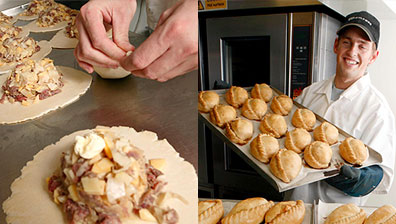
Henceforward a Cornish pasty is a savoury, D-shaped pasty which is filled with beef, vegetables and seasonings. Any sort of pastry can be used provided it is savoury and 'robust enough to retain shape throughout the cooking, cooling and handling process and serves to avoid splitting or cracking.' The pastry is crimped by hand or mechanically 'to one side, and never on top'.
A Cornish pasty must contain not less then 25% vegetables which must be sliced or diced potato, swede/turnip and onion only, not less than 12.5% meat which must be minced or diced beef and seasonings. No other types of meat or vegetables or any artificial additives can be used and all filling ingredients must be uncooked at the time of sealing the product.
And to be called a Cornish pasty the product must be assembled in the designated area of Cornwall.
Now the European Commission don't go around the countryside looking for things to classify, chances are they would never have heard of the Cornish pasty if it hadn't been for the Cornish Pasty Association. And who are they? Well you might not be entirely surprised to learn that they are a group of Cornish pasty makers who just happen to all be in Cornwall and are concerned 'to protect the quality and the reputation of the Cornish pasty and to stop consumers being misled by pasty makers who trade off the value of the name without producing a genuine product.' They believe 'protection of the Cornish pasty is necessary in order to safeguard the heritage of the Cornish pasty, the future of the industry and the reputation of the product.'
Safeguarding traditional foodstuffs and the heritage of their production is all part of the modern nostalgia for the past, a back lash against the commercialisation of food production and the fear that local traditions and even national identities will disappear into the blandness of globalisation. In Cornwall the pasty is historically associated with the mining industry. It was a neat, convenient and economical meal for the labouring man. The crimped edge was held by the miner as he ate and then discarded because contaminated with the grime from his hands. So the pasty is an unashamedly proletarian foodstuff, a reminder of hard times and hard work. Now that the mining industry in Cornwall is no more (although the mining landscape has been granted World Heritage Status) the poor pasty becomes a potent symbol of the 'good old days' albeit one which is commercialised and now standardised.
Will being granted PGI achieve the stated aims of the Cornish Pasty Association? Simply standardising the ingredients is surely no guarantee of the quality of the finished product. To qualify to carry a Cornish pasty logo, proof of authenticity, there is no requirement that the raw ingredients be sourced from within Cornwall, so there is no suggestion, for example, that turnips grown in Cornish soil are essential to the final flavour. Many consumers are unlikely to find a pasty made with puff pastry equal in quality to one made with shortcrust pastry (made with lard of course), and many consumers already consider that a pasty made with mince in highly inferior to one made with diced beef whether made in Cornwall or not. In fact to qualify as Cornish it is only 'the assembly of the pasties in preparation for baking' which must take place in the designated area, the actual baking does not have to be done in Cornwall. So what's Cornish about the Cornish pasty?
Is it cynical to suggest that the Cornish Pasty Association is less interested in protecting the good name of the pasty and more interested in the future of the industry in Cornwall and ensuring that 'consumers willing to pay a premium price for a genuine article' will make an appropriate contribution to the Cornish economy?
Safeguarding tradition is something that Cornish families have been doing for centuries and Cornish pasties are consumed in countries around the world. Does it matter that some of them may contain carrots and have the crimping on the top rather than at the side? Perhaps it is no bad thing that there is some standardised recipe for a Cornish pasty just so that no one ever gets the idea that pastry stuffed with Tandoori chicken might have originated in Cornwall but to suggest that only pasties which are made to that recipe AND 'assembled' in Cornwall can rightfully be called Cornish pasties seems – well at least odd, if not down right silly.
For more on the Cornish pasty and what some people think of the granting of PGI status see here and here
The Cornish Pasty Association are here and you can read their application for PGI status here and click on the link.
The images above are from the Cornish Pasty Association website.
Monday, February 21, 2011
On discovering Mary Frances Kennedy Fisher
![]() |
| This photograph of M. F. K. Fisher in her study, April 28 1971 by Robert Drew, appeared in the Guardian, 11 August 2010. |
'Mrs. Fisher is as talented a writer as she is a cook. Indeed, I do not know of anyone in the United States today who writes better prose. If a reader wishes to test this assertion, let him turn to the first three pages of the section in An Alphabet for Gourmets entitled I is for Innocence.'
So says W. H. Auden, writing in 1963, in his introduction to The Art of Eating, a compilation of five of M.F.K. Fisher's books – Serve it Forth (1937), Consider the Oyster (1941), How to Cook a Wolf (1942), The Gastronomical Me (1943) and An Alphabet for Gourmets (1949). As a newcomer to Mrs.Fisher's prose, I decided I should begin by testing it as suggested.
In ' I is for Innocence' she writes of the ghastliest meal of her life which was prepared for her by a friend she describes as 'a large, greedy and basically unthinking man'. The point of the story is that food prepared with some 'warmth and understanding', with honesty and generosity will always please even if the food itself is dreadful. Mrs. Fisher asserts that 'A truly innocent cook or host is never guilty of the great sin of pretension, while many an ignorant one errs hideously in this direction'. And a man capable of pretension is not only cheating his guests but is also 'incapable of telling the truth to himself'. Strong stuff, but Mrs. Fisher is nothing if not opinionated.I wouldn't have said that the three pages of this anecdote represented the very best of her writing but then I am no W. H. Auden, nor, to be truthful, am I a fan of Mary Frances Kennedy Fisher. I admit this with some trepidation given the praise lavished on her by the likes of Paul Levy, Allan Davidson, Jane Grigson and a host of other writers. On the whole I found her prose dense and convoluted and a bit obscure. There is something about the tone of her writing that smacks of smugness and superiority which made me think of her as rather uncharitable and unsentimental. Would you say of someone who is a friend that they were 'large' and 'greedy' and 'basically unthinking'? Would you, to prove a point, tell the world that this man produced the ghastliest food you had ever eaten? So whilst I understand and appreciate what she is getting at in 'I is for Innocence' I feel very uncomfortable with the way she goes about it. It's not what she says that I object to, just the way that she says it.
Some of her pieces, particularly those in The Gastronomical Me, are highly personal, almost embarrassingly so, but at the same time strangely impersonal. She tells you just so much and no more so that many of the stories are inconclusive and you find yourself wondering what it was all about. Obviously fiercely independent she paints a portrait of herself as both feminine and staunchly feminist but somehow never seems to quite let you see her real self.
That's not to say that she doesn't have a way with words and she can tell a good story, more importantly she has some good stories to tell but in the end I felt unwelcome. I didn't feel that we had been on the journey together or that she cared much about her reader. Overall the tone of much of her prose struck me as not just self-confident but studied and self-indulgent.
Friends tried to convince me that I was the one being ungenerous, that perhaps I should allow for the writing having dated somewhat, and of course for every one of my negatives they were able to point to pages of positives, to expressive and perceptive passages, to eloquent descriptions and witty analogies.
Whilst I could see what they are getting at I still felt disappointed. Perhaps Mary Frances and I were just not on the same wavelength. I searched to find anyone who agreed with me and then I found Gay Bilson's admission that she finds M. F. K. Fisher's prose 'toe-curling' and objects to 'an ever-present sense of self-congratulation' in Fisher's writing*. Like Gay Bilson I was relieved to find that there is a 'cadre' of others prepared to admit foodie heresy.
I was left wondering what it was I had expected and what it was I wanted from food writing. The simple answer of course is that good food writing should just be good writing, and that good writing is about words and not about food. Mrs. Fisher's oft quoted reasons for writing about food make it clear that she sees herself as a writer not as a food writer.** Food writing is writing about food; food writers are writers who write about food. But, as any member of a book group will tell you, one person's idea of good writing is another person's complete waste of time. Ultimately you either like it or you don't.
*Plenty. Digressions on Food. Lantern, 2004
**In the forward to The Gastronomical Me she writes
'People ask me: Why do you write about food and eating and drinking? Why don't you write about the struggle for power and security, and about love, the way others do?They ask it accusingly, as if I were somehow gross, unfaithful to the honor of my craft.The easiest answer is to say that, like most other humans, I am hungry. But there is more than that. It seems to me that our three basic needs, for food and security and love, are so mixed and mingled and entwined that we cannot straightly think of one without the others. So it happens that when I write of hunger, I am really writing about love and the hunger for it, and warmth and the love of it and the hunger for it...and then the warmth and richness and fine reality of hunger satisfied...and it is all one.'
Friday, February 11, 2011
Lumberjack Cake?
Today I made Lumberjack cake - following the tried and true recipe on the Women's Weekly recipe card - it's one of my staples. Always a success, always enjoyed and easy enough to put together for afternoon tea so long as you don't leave it too late to prepare the dates. But why is it called Lumberjack cake?
Searching the Internet doesn't provide any clues other than that it is sometimes referred to as 'Loggers cake'. But what does it have to do with lumberjacks or loggers? The specific ingredients which make this cake different to any other - dates, apples and coconut - aren't specific to lumberjacks, are they? Nor are they likely to be the sort of staples you would expect to find in a logging camp, are they? It's all just a little bit mysterious.
Even Python lumberjacks don't eat cake, well not on Wednesdays anyway.
Searching the Internet doesn't provide any clues other than that it is sometimes referred to as 'Loggers cake'. But what does it have to do with lumberjacks or loggers? The specific ingredients which make this cake different to any other - dates, apples and coconut - aren't specific to lumberjacks, are they? Nor are they likely to be the sort of staples you would expect to find in a logging camp, are they? It's all just a little bit mysterious.
Even Python lumberjacks don't eat cake, well not on Wednesdays anyway.
I'm a Lumberjack and I'm okay,
I sleep all night and I work all day
I cut down trees, I eat my lunch
I go to the lavatory
On Wednesdays I go shopping
And have buttered scones for tea
Monday, February 7, 2011
The Bocuse d'Or 2011
The Bocuse what? you might ask - although you would know all about it if you had read this post from 2009 (which discusses a film about the Spanish 2007 bid and also explains the workings of the competition). While at home Queenslanders have been a bit preoccupied with floods over in France one of their number has been flying the Australian flag at the Bocuse d'Or in Lyon, France. You wouldn't know much about this event if you relied on the Australian press (I could only find one recent reference here) but it seems to be taken pretty seriously in Europe and increasingly so in the USA.
This year the 24 contestants had to prepare a meat platter, using two saddles of lamb, including the kidneys, and one shoulder, and a seafood platter using two monkfish, twenty langoustines and four crabs. The end results are presented on huge platters and paraded before the 24 judges, 12 of who sample the meat dishes and the other 12 taste the fish.
What remains a bit of a mystery is what the judges are looking for. The Americans were very disappointed with their performance, coming 10th, and attribute their lack of success to not understanding the 'game', 'the defined game in the way that the food should be presented'. Given that any bid doesn't come cheaply it would seem fundamental to understand what is expected before competing. Obviously all the chefs who enter know how to cook so is the competition less to do with execution and more about style? Apparently the winning platter needs to demonstrate passion and originality and be a true expression of the chef.
The winning team from Denmark scored 1014 points; only six other teams scored more than 900; the Americans scored 864. Of the thirteen competitions held since 1987 France has won six times and Norway four times. The place getters have always been European or Scandinavian teams with the exception of Singapore who scored a bronze in 1989. Clearly some contestants have a better idea of what the judges are looking for than others in particular Rasmus Kofoed who won gold for Denmark this year, silver in 2007 and bronze in 2005!
This clip sums up his approach to the 'game'
What I don't really understand is what the chefs gain from this sort of contest. As Grant Achatz points out competition cooking has little or nothing to do with restaurant cooking and, despite the fact that he was a judge of the Bocuse d'Or USA which chose the team to go on to Lyon this year, he quite bluntly says
Our local boy was Russell Clarke, senior sous chef at the Brisbane Convention and Exhibition Centre. Perhaps one of the reasons why there hasn't been much publicity of the event here has something to do with the result - the Australians came in at number 20 with a score of 711.
For information about the Bocuse d'Or see here
For Grant Achatz on the Bocuse d"or USA see here
For Michael Ruhlman's coverage of the 2011 event see here, here and here
For another first hand report on the US bid see here, and for a report on how the British team fared see here
And if anyone can tell me how to embed a YouTube video so that it doesn't take over the whole page I would be forever grateful.
This year the 24 contestants had to prepare a meat platter, using two saddles of lamb, including the kidneys, and one shoulder, and a seafood platter using two monkfish, twenty langoustines and four crabs. The end results are presented on huge platters and paraded before the 24 judges, 12 of who sample the meat dishes and the other 12 taste the fish.
What remains a bit of a mystery is what the judges are looking for. The Americans were very disappointed with their performance, coming 10th, and attribute their lack of success to not understanding the 'game', 'the defined game in the way that the food should be presented'. Given that any bid doesn't come cheaply it would seem fundamental to understand what is expected before competing. Obviously all the chefs who enter know how to cook so is the competition less to do with execution and more about style? Apparently the winning platter needs to demonstrate passion and originality and be a true expression of the chef.
The winning team from Denmark scored 1014 points; only six other teams scored more than 900; the Americans scored 864. Of the thirteen competitions held since 1987 France has won six times and Norway four times. The place getters have always been European or Scandinavian teams with the exception of Singapore who scored a bronze in 1989. Clearly some contestants have a better idea of what the judges are looking for than others in particular Rasmus Kofoed who won gold for Denmark this year, silver in 2007 and bronze in 2005!
This clip sums up his approach to the 'game'
What I don't really understand is what the chefs gain from this sort of contest. As Grant Achatz points out competition cooking has little or nothing to do with restaurant cooking and, despite the fact that he was a judge of the Bocuse d'Or USA which chose the team to go on to Lyon this year, he quite bluntly says
'Historically, most chefs in the U.S. could not see the benefit of devoting time and energy to train for a competition that would not further their careers, even if they did win.'
Our local boy was Russell Clarke, senior sous chef at the Brisbane Convention and Exhibition Centre. Perhaps one of the reasons why there hasn't been much publicity of the event here has something to do with the result - the Australians came in at number 20 with a score of 711.
For information about the Bocuse d'Or see here
For Grant Achatz on the Bocuse d"or USA see here
For Michael Ruhlman's coverage of the 2011 event see here, here and here
For another first hand report on the US bid see here, and for a report on how the British team fared see here
And if anyone can tell me how to embed a YouTube video so that it doesn't take over the whole page I would be forever grateful.
Subscribe to:
Posts (Atom)