Thursday, January 26, 2023

Mrs Joel's Cookery Book


 On 6 October 1915 Vera Prior Hick married William Clayton-Joel at her parent’s home in Williamstown.[1] Vera was the youngest daughter of Alexander White Hick and his wife Emma (née Box). The extended Hick family were long-time, prominent residents of Williamstown, and, entwined with other local families through marriage, had significant business interests in the town. The Hicks were also active in the local community. Vera’s father was secretary to the Williamstown Cemetery, a founding member of the Williamstown Bowling Club and the family had strong connections to the Methodist Church. Alexander’s obituary described him as ‘one of Williamstown’s most respected residents’.[2] Her husband also came from an established Williamstown family.  William Joel was the son of William Clayton-Joel and Elizabeth (née Clark) and worked in his father’s electrical engineering company.[3] The newlyweds made their home at 45 Railway Place, Williamstown and Vera brought with her a copy of the newly-published The Common-Sense Household Cookery Book, compiled by the New South Wales Cookery Teacher’s Association, which she proudly emblazoned with her new name and address.[4]


    Given that she came from a very comfortable middle-class family it is possible that Vera had little domestic experience or culinary skill. A note pinned to the final page of her cookbook providing guidance on ‘Serving Dinner’:

Have 3 extra plates hot in the oven, 1 for baked veg., 1 for joint of meat, 1 for carved meat.

Prepare boiled veg for serving.

Take up meat and baked veg, & replace in oven.

Make gravy.

Carve meat on 1 plate (leaving rest on plates in oven). 

Distribute meat and veg on the different plates & put back in oven for a few minutes.

tends to support the notion that she was perhaps a novice in the kitchen. If so, then the simple recipes and straightforward instructions in the Common-Sense Cookery Book would be particularly useful.


    It is often suggested that the best way to determine favourite recipes is to look for stains and splodges on the pages in cookbooks to which reference was regularly made. Vera’s book is now over one hundred years old but shows remarkably few signs of this sort of wear and tear. That the book is well preserved does not of course mean that it was not used and valued. At some time, a neat hole has been bored through from front to back and a loop of string inserted, presumably so that the book could be hung up somewhere convenient in the kitchen. In fact, the absence of staining may well indicate that the text was treasured and carefully protected from spills and splatters. There is also clear evidence that Vera did refer to certain recipes and that she was interested in adding to her culinary knowledge. 


    Throughout there are notes which Vera has made. Many recipes have been annotated in one way or another. Some have ingredients highlighted others have an alternative recipe pencilled alongside. For example, the ‘First stock for clear soup’ recipe calls for 1 doz. Cloves and 1 doz. peppercorns but Vera’s notes round this down to 2 cloves and 3 peppercorns, and either in addition to, or instead of, the bouquet garni in the original recipe she includes marjoram and parsley. Next to the recipe for ‘Sago Pudding’ are pencilled directions for an alternative process and alongside the instructions for 'Banana Custard' is a note to cool the custard before pouring over the bananas. Other reminders include the notes made beside the recipe for ‘Jam Sandwich’ – ‘light bottom gas when starting – top gas when eggs and sugar are finished’. Substitute recipes for 'Lemon Tart', 'Suet Crust', 'Quickly-made Apple Pudding', 'Liver and Bacon' (Vera’s recipe adds onions) all suggest experimentation, corrections made which reflect knowledge gained from experience, and alternatives better suited to her own skills and her own tastes. 


    These new ideas came from various sources. A note on page 13, under the heading 'Stocks and Soups', says ‘See also PWMU Soups’ which suggests that her kitchen shelves housed the recipes put together by the Presbyterian Women’s Missionary Union of Victoria.[5] She sourced recipes from newspapers – a hot water pastry for Steak and Kidney Pie, instructions for making 'Egg Sandwiches', 'Vanilla Slices', 'Orange Cake', 'Baked Bananas' and for cooking a 'Tough Fowl' – have been neatly cut out and firmly pasted onto appropriate pages. No doubt others were recommendations from friends - an added recipe for 'Flaky Pastry' is headed ‘Mrs Stubb’s recipe’. The recipe which appears to have given Vera the most trouble is that for 'Cream Puffs'. Here she has made several changes to the quantities of ingredients, made amendments to the method, and pasted in a recipe supplied to the women’s page of the Argus.[6] Of course, there is no way of assessing Vera’s success in the kitchen or her enthusiasm for cooking but tracing these newspaper clippings confirms that Vera, a regular reader of the Argus, continued to add to her recipe collection at least until the mid-1920s.[7]


    While Vera’s book does not reveal much information about what meals she may have prepared her additions to the text do give a glimpse of her interests and her domestic role. For example, Vera’s kitchen was also the place for concocting home remedies. Like most recipe collections of the period the Common-Sense Household Cookery Book provided a section of recipes suitable for invalids, which included light dishes like steamed fish and savoury omelette, and nourishing fare such as beef tea and chicken broth. To the two published recipes for 'Barley Water', Vera added two of her own which may indicate this was a ‘medication’ often invoked. She also added remedies ‘for warding off colds’ which include a treacle posset (1-2 tablespoons of treacle added to 1 pint of boiling milk), 'Onion Gruel' (to be taken hot ‘when in bed or not going out’, and the recommendation to ‘put feet in hot mustard and water when retiring’. How efficacious these treatments were is not recorded.


    Nothing if not thorough, the Common-Sense Household Cookery Book provided step-by-step directions for preparing cocoa, tea (‘Use a food quality tea, and an earthenware teapot’) and coffee. It appears that Vera was unaccustomed to making coffee since, along with the notation ‘1 dessertsp. coffee to 3 cups of liquid (weak), 1 dessertsp. coffee to 2 cups liquid (strong)’ she transcribed three sets of directions for preparing coffee to drink, the most obscure of which was clearly designed for making large quantities. The ingredients are listed as:

1/2 lb (approx. 250 g) coffee, (whether ground or beans is not specified)

3 qrts (6 pints or approx. 3.5 litres) milk

copperful water (without knowing the exact volume of a laundry copper this would probably amount to around 20 litres or perhaps more)[8]

The directions involve putting the coffee into a muslin bag, placing the bag in the copper with the water, along with an unspecified amount of salt, and bringing the water to the boil before adding the milk. Again there is no record of where, when or why Vera ever had recourse to making coffee on this scale.


    William retired from the family business in 1953 and died in 1961 at the age of 73.[9] Vera died in 1990, aged 98. Unfortunately there is nothing to confirm that Vera ever master the making of cream puffs.


[1] Argus, 18 December 1915, p. 3.

[2] Williamstown Chronicle, 22 October 1938, p. 4 “Death of Mr A.W. Hick’.

[3] See Clayton-Joel and Co. Golden Jubilee (1889-1939) publication here. 

[4] Vera inscribed ‘Vera P. Joel’ on the front cover and her name and address on the title page. The Common-Sense Household Cookery Book, compiled by the Cookery Teacher’s Association of New South Wales (Sydney: Angus & Robertson, nd 1914/15?). 

[5] The P.W.M.U. Cookery Book of Victoria (Melbourne: Brown, Prior & Co. first published 1916) Before 1916 the PWMU publication was titled Home Cookery for Australia.

[6] The recipe request by ‘Beate’ of Green Lakes was published in Argus, 26 June 1918 (p. 12, ‘Women to Women’). The recipes for ‘Pastry for Pies’, ‘Whipped Cream’ and ‘Orange Cake’ also came from this edition of the Argus.

[7] ‘Baked Bananas’, and ‘Vanilla Slices’, Argus, 25 December 1918, p. 8; 'Egg Sandwiches', Argus, 11 January 1922, p. 5; ‘To cook a tough fowl’, Argus, 6 January 1926, p. 6.

[8] For those unfamiliar with a laundry copper see here. 

[9] Age (Melbourne), 21 May 1953, p. 13; Victorian Births, Deaths and Marriages index.

Saturday, December 24, 2022

A Merry Jelly Christmas

What to serve for the Christmas meal that is suited to the local climate is something which has exercised the imagination of Australians for many years. Plum pudding in particular has long been deemed entirely inappropriate for the local conditions. While some may have dreamed that one day the stodgy plum pudding would be superseded by ‘some delicate, delicious, fairy-like masterpiece, some wonderous cunning blending of choicest fruits and merigued trifle and exquisite jelly’,[1] the idea of a jellied pudding did not really arouse much interest until the 1930s when ice boxes and refrigerators were becoming increasingly common in kitchens, and powdered gelatine and packets of jelly crystals were readily available. Not that the idea of combining the ingredients you might expect to find in a Christmas pudding with jelly was an entirely original idea. 

For example, way back in 1660, in The Accompisht Cook, Robert May had included instructions ‘To make another excellent Jelly of Harts horn and Ising-glass for a Consumption’. This involved making a gel with both hartshorn and isinglass, and adding sugar, sliced figs, sliced prunes, ginger, mace, cinnamon, nutmeg and cloves. (The recipe also calls for red sanders and liquorice, the former probably largely for colouring, but both were thought to have medicinal properties.) Whether the result was any help to the consumptive, it does bear some resemblance to a jellied Christmas pudding. Similarly in The Experienced English House-keeper (first published in 1769 and enlarged in 1771) Elizabeth Raffald, provided directions ‘To make a TRANSPARENT PUDDING’ which involved alternating layers of clear calf’s foot jelly with blanched almonds, raisins, citron, candied lemon and currants, another recipe which includes some familiar plum pudding ingredients. Of course, neither Raffald nor May lay any claim to either of these concoctions being Christmas puddings. The impetus for a jellied Christmas or plum pudding finally came from commercial interests promoting the use of dried fruits and locally manufactured gelatine. 

Trying to establish where and when the first recipe for a jellied plum pudding was published is a futile exercise, however there is ample evidence to suggest that the idea dates from the early 1920s.[2] The Davis Gelatine Company had been manufacturing gelatine in Sydney since 1919. In 1921 the company announced their intention to publish a book of recipes and solicited contributions from the public.[3] The first edition of Davis Dainty Dishes was printed in 1922 and included a recipe for Christmas Plum Pudding.[4]

In July 1923 the Australian Dried Fruits Association (hereafter ADFA) awarded Mrs Bessie Potts of Armadale, Melbourne, a consolation prize for her recipe for Gelatine Christmas Pudding. It was duly printed in the pages of the Argus newspaper. [5]

The following table compares these two recipes.

Table 1.

Ingredients

Davis Dainty Dishes

 Argus, 4 July 1923, p. 20

gelatine

3 dessertspoons

3 dessertspoons

Milk

1½ pints

1½ pints

Sugar

1 cup

1 cup

chocolate

1½ squares

1 square

cocoa

3 tablespoons


raisins

1 cup

1 cup

currants

½ cup

½ cup

Lemon peel and nuts

¼ pound

¼ pound

Dates or figs

½ cup


prunes


½ cup

Dried peaches or pears


1 cup

Vanilla essence

½ teaspoon


salt

pinch

pinch


From the similarity of these two formulations, it seems likely that Mrs Potts derived her recipe from that originally published by Davis Gelatine and was the first of many who contributed their own reworking of the recipe to newspapers over the following decades. Variations on this theme, that is using gelatine, chocolate, milk and a mixture of dried fruits, became by far the most common incarnation of a cold Christmas pudding, no doubt as a direct result of promotion by Davis Gelatine and regular newspaper advertising by the ADFA and inclusion of the recipe in ADFA publications.[6]

Clearly, although served cold, the jellied pudding was intended to resemble the traditional boiled pudding as closely as possible, even down to recommendations to decorate the pudding with sprigs of holly. The fruit combination and spices, where used, follow standard plum pudding formulas and every attempt was made to give the solid appearance and brown colour of a cooked pudding. 

Adaptations over the years involved more or less gelatine, more or less fruit and different combinations of fruit, the use of strong black coffee or coffee essence instead of or as well as chocolate and/or cocoa,[7] and the addition of stiffly beaten egg whites.[8] A more elaborate recipe published in the Hobart Mercury incorporated cream, ground almonds preserved ginger and maraschino cherries along with muscatels, dates and figs.[9] The cookery expert writing in the Daily Telegraph(Sydney) combined gelatine, milk, black coffee and cocoa, raisins, dates, cyrsytallised cherries, crystallised pineapple, marzipan meal and condensed milk. This mixture was beaten until thick and creamy and a stiffly beaten egg white was folded through before it was set in a mould.[10] Another version published in The Australian Women’s Weekly improved on the basic recipe with the addition of evaporated milk, glacé cherries and even the traditional trinkets and threepences.[11] As late as 1968 Golden Circle advertising was promoting a Cold Christmas Pudding set with gelatine which involved milk, cocoa, dates, raisins, sultanas and cherries mixed with a can of crushed pineapple.[12]

A far less popular way to achieve an appropriate colour was to use prune juice rather than chocolate, as in this earlier recipe from the Weekly:

Boil ½ lb prunes in 2 cups water and cinnamon to taste. Dissolve 2 tablespoons gelatine in ½ cup cold water, pour on ¾ cup hot prune juice. Add ¼ cup chopped figs, the cooked and stewed prunes, ½ cup seeded raisins, ½ cup sugar, juice 3 oranges, juice 2 lemons, 3 tablespoons sherry or brandy, 1 oz. peel, 2 oz. cherries, and nuts if liked. Mix well. When beginning set put into a wetted mould. Chill. Turn out. Decorate with whipped cream, chopped cherries and nuts.[13]

Jelly crystals were also recommended as the basis for a jellied pudding, and, although no advertisements have been found, it is likely that these recipes also originated in promotion by manufacturers of jelly mixes. Sometimes lemon flavoured jelly crystals were specified but more often it was raspberry or some other darkly coloured blend. [14] The simplest of these versions suspended a combination of fruits and nuts in the clear, flavoured jelly. Others, again in emulation of a traditional plum pudding recipe, incorporated breakfast cereal or bread, or biscuit, crumbs. The following recipe promised a Jelly Plum Pudding which was light and digestible, and had all the traditional richness and mellow flavour without the bother:

Dissolve a package of lemon jelly in a pint of boiling water, and when still hot stir in ¾ cupful of grape nuts [sic], ¾ cupful of seeded raisins, ¾ cupful of walnut meats, ¾ cupful of cooked prunes, ½ cupful of citron – all cut fine. Also add ½ teaspoonful of cinnamon, and ¼ teaspoonful of cloves. Salt to taste. Mix and let harden.[15]

An imported product, the uses of Grape Nuts were promoted with recipes published in Australian newspapers and distributed in booklets. Given the use of a specific brand name it is likely that this pudding recipe also had its origins in commercial advertising. The similarity of Later recipes, which incorporated bread or biscuits crumbs, Weetbix, and even Rice Bubbles, bear a striking similarity to the one above from 1927 suggesting that these were more readily achievable and perhaps more economical versions of some published original.[16]

Truly original recipes, that is those which do not appear to be just some reinterpretation of an already published idea, were few and far between. A few recipes attempted to produce a decorative result emulating the layered pudding suggested by Raffald.[17] Mrs Dunham of Launceston was one who saw potential in a more attractive appearance: 

Make up a pint of lemon jelly and pour to depth of half inch in the bottom of a damp mould. On this arrange a pattern of seeded muscatels and fill in spaces with blanched almonds. Put on top of ice to set firmly. Into remaining jelly mix ¼ lb stoned muscatels, 3 oz roughly broken walnuts, 2 oz chopped candied cherries, 1 oz chopped candied figs, half a grated nutmeg, ¼ teaspoon cinnamon, 1/8 teaspoon spice. When this begins to jell, pour into the prepared mould and set firm. Serve with whipped cream.[18]

Marshmallow Plum Pudding involved layering marshmallows with a mixture of raspberry flavoured jelly, raisins, sultanas and lemon peel.[19]

Although the jellied pudding itself was suggested as ideal for the climate, there seems to have been little enthusiasm for giving the pudding a distinctive Australian flavour. Aside from the pineapple recipe already mentioned, the only other non-traditional ingredients were coconut (which featured in only three instances)[20] and bananas. 

An early banana version also involved the use of grated raw carrot:

Mix together equal parts of seeded raisins, sultanas, grated nuts, grated raw carrot and chopped figs. Blend well with 2 ripe mashed bananas and a little honey, stir in 1 cup unset jelly (and a little wine if desired) and put away to chill in small wet moulds. Turn out onto sweet dishes and serve with spiced egg custard, clotted cream or any fancied Christmas sauce (cold).[21]

Bananas were an ingredient in a later recipe for cold plum pudding published by Davis Gelatine: 


Australian Women’s Weekly, 29 October 1958, p. 81. [22]


If the number of published recipes is a guide, interest in jellied puddings for Christmas declined after the 1940s. Of the 170 recipes surveyed here more than 75 percent were published between 1923 and 1949. Of the four recipes sourced from the 1970s, two were repeats of the David Gelatine recipe above,[23] and two were a more sophisticated reworking of a familiar theme from thirty years earlier, published in the Weekly:

Jellied Christmas Pudding
8 oz raisins, 1lb sultanas, 4oz currants, 2 oz mixed peel, ¾ cup sugar, 2 cups water, 2oz glace cherries, 2 oz glace apricots, 2 oz toasted slivered almonds, 11/3 cups water, extra, 3½ tablespoons gelatine, 1 cup sweet sherry, ¼ cup brandy, ¼ cup lemon juice, 1oz glace cherries, extra.
Chop raisins finely; combine with sultanas, currants and mixed peel. Wash thoroughly, drain. It may be necessary to wash fruit several times so that it is completely clean; this will ensure a beautifully clear, jellied pudding. Combine fruit, sugar, and water in saucepan, stir over low heat until sugar is dissolved; increase heat slightly; simmer uncovered 10 minutes. Drain, reserve liquid, strain liquid through fine cloth. Place fruit and strained liquid into large basin, add finely chopped glace cherries and apricots. Add gelatine to extra water, stand 5 minutes, dissolve over hot water, add to fruit mixture. Add almonds, sherry, brandy, and lemon juice, mix well. Take 1/3 cup liquid from the fruit mixture, pour half over base of oiled 8 in. baba tin or 3-pint mould; refrigerate until partly set. Quarter extra cherries, arrange decoratively in jelly, pour over remaining liquid. Refrigerate until set. Top with fruit mixture.
Refrigerate overnight.
Unmould carefully. This pudding is best eaten within three days of making.[24]

How many families did, or do, enjoy a jellied plum pudding at Christmas is a moot point, but it is true to say that the concept has not been widely adopted. Why? There are any number of reasons but surely no amount of cocoa or breadcrumbs or brandy could make a jellied plum pudding taste or eat like a traditional plum pudding. Perhaps most importantly a shiny, wobbly brown jelly studded with fruity lumps was never likely to look as appetising as traditional plum pudding, boiled or steamed, although, as this photograph from the Australian Women’s Weekly attests, plum pudding, in any of its forms, is perhaps not as Instagramable as it might be.


Australian Women’s Weekly, 2 December 1970, p. 13.


[1] ‘A Lady’s Letter from Sydney’, The Mercury (Hobart), 29 December 1891, p. 3.

[2] The following discussion is based on 170 recipes, sourced from Australian newspapers and the Australian Women’s Weekly via the National Library of Australia database Trove, covering the period from 1920 to 1980. Recipes were variously titled Jellied Christmas Pudding, Jellied Plum Pudding, Gelatine Plum Pudding, Chocolate Plum Pudding, Cold Plum Pudding, Cold Christmas Pudding, etc.

[3] Weekly Times (Melbourne), 10 December 1921, p. 69.

[4] See also advertising Country Life Stock and Station Journal (Sydney), 31 October 1924, p. 5

[5] ‘A.D.F.A. Recipe Competition’, Argus, 4 July 1923, p. 20 https://trove.nla.gov.au/newspaper/article/2015700?searchTerm=sunraysed

[6] More than 60 percent of the recipes in this survey used gelatine in combination with milk and/or cocoa and chocolate. For recipes included in ADFA publications see Sun-Raysed Dried Fruit and Raisin Recipes (Melbourne: Australian Dried Fruits Association, 192?), under the title Chocolate Plum Pudding, and in the Australian Sunshine Cookery Book  (Melbourne: Australian Dried Fruits Association, 194?) as Jelly Plum Pudding. 

[7]  Cold Plum Pudding, Daily Telegraph (Sydney), 27 November 1949, p. 60. http://nla.gov.au/nla.news-article248155577; Jellied Christmas Pudding,  Australian Women’s Weekly, 2 December 1953, p. 40, http://nla.gov.au/nla.news-article41080177

[8] Chocolate Plum Pudding, Mount Barker Courier and Onkaparinga and Gumeracha Advertiser (SA), 31 October 1930, p. 3, http://nla.gov.au/nla.news-article147849547; Jelly Plum Pudding, Table Talk (Melbourne) 17 December 1931, p. 31, http://nla.gov.au/nla.news-article147417153.

[9] Iced Plum Pudding, Mercury (Hobart) 25 November 1936, p. 14, http://nla.gov.au/nla.news-article30124716.

[10] Cold Plum Pudding, Daily Telegraph Sydney, 27 November 1949, p. 60, http://nla.gov.au/nla.news-article248155577.

[11] Jellied Christmas Pudding, Australian Women’s Weekly, 14 December 1955, p. 73, http://nla.gov.au/nla.news-article48072238. Ingredients: One tablespoon cocoa, 2 cups milk, 1 dessertspoon coffee essence, ¼ cup minced peel, ½ cup chopped raisins, ¼ cup chopped sultanas, 6 tablespoons sugar, 1½ tablespoons gelatine dissolved in ¼ cup boiling water, ½ cup evaporated milk, 2 oz crystallised or glace cherries, 2 tablespoons brandy or sherry, trinkets or threepences, holly springs, whipped cream sweetened and flavoured with brandy. Method: Blend cocoa with milk, bring to boiling point. Add coffee essence, peel, raisins, sultanas and sugar. Simmer 5 minutes, allow to become cold. Fold in dissolved gelatine, evaporated milk, cherries, brandy, and trinkets or threepences. Stir occasionally until mixture begins to thicken, then spoon into individual moulds or recess-tins. Chill until set. Unmould and serve topped with a spoonful of brandy-flavoured whipped cream, decorate with holly.

[12] Golden Circle advertisement Cold Christmas Pudding, Australian Women’s Weekly, 11 December 1968, p. 51, http://nla.gov.au/nla.news-article45650025.

[13] Jellied Plum Pudding, Australian Women’s Weekly, 3 December 1938, p. 3, http://nla.gov.au/nla.news-article55464709.

[14] Jellied Christmas Pudding, Examiner (Launceston), 3 November 1937, p. 10, http://nla.gov.au/nla.news-article52167823; Jellied Plum Pudding, Age (Melbourne) 27 November 1947, p. 2, http://nla.gov.au/nla.news-article206055697.

[15] Jelly Plum Pudding, Chronicle (Adelaide) 24 December 1927, p. 73 http://nla.gov.au/nla.news-article90084124. Grape Nuts was an imported breakfast cereal, its various uses were promoted with recipes in newspapers and recipe booklets, for example Daily Telegraph 29 June 1907, p. 10, http://nla.gov.au/nla.news-article238042693.

[16] Iced Jelly Plum Pudding, Sunday Mail (Brisbane) 15 December 1929, p. 4, http://nla.gov.au/nla.news-article97660385: Dissolve 1 packet lemon jellex in 1 pint boiling water, and while it is still hot stir in 1 cup coarse dried and browned breadcrumbs, ¾ cup of stoned raisins, ¾ cup walnuts, ¾ cup cooked prunes, and ½ cup citron peel, all cut finely, ½ teaspoon cinnamon, ¼ teaspoon cloves and salt to taste. Mix and let harden. Stand on the ice, and when required slice it; serve with whipped cream or pudding sauce. For White’s jelly crystals and rice bubbles, Jellied Plum Pudding, http://nla.gov.au/nla.news-article46461995, AWW 15 February 1936, p. 16; (The Times and Northern Advertiser (Peterborough, SA), 18 December 1936, p. 4). For Weetbix, see Jellied Plum Pudding, Longreach Leader (Queensland),18 December 1953, p. 4, http://nla.gov.au/nla.news-article124264240.

[17] A layered result may have been the intention of this recipe from a Brisbane newspaper, although the instructions are not explicit: Two pint packets of yellow or red jelly crystals as preferred. Melt the two packets of crystals in a scant pint and a half of boiling water. Wet a pudding basin. Pour in a thin layer of jelly. Cover with a layer of prepared fruits, then a layer of jelly. Continue until all material is used up. Then put away to set. The prepared fruits are ¼ lb of seedless raisins, ¼ lb currants, same of sultanas, 2 oz crystallised cherries, 1 oz blanched almonds, 1 oz walnuts. To prepare wash the fruit and cover with boiling water. Let stand 10 minutes and then dry thoroughly. Plum Pudding in Jelly, The Telegraph, 16 December 1935, p. 20, http://nla.gov.au/nla.news-article179944348.

[18] Jellied Christmas Pudding, Examiner (Launceston, Tas.), 3 November 1937, p. 10, http://nla.gov.au/nla.news-article52167823

[19] Marshmallow Plum Pudding, The Land (Sydney), 6 December 1946, p. 22, http://nla.gov.au/nla.news-article105700572.

[20] Jellied Plum Pudding, Truth (Brisbane, Queensland), 20 December 1931, p. 24, http://nla.gov.au/nla.news-article203925870; Jelly Plum Pudding, Macleay Argus (Kempsey, NSW) 24 December 1952, p. 2, http://nla.gov.au/nla.news-article234663173; Christmas Party Plum Puddings, Australian Women’s Weekly, 25 December 1968, p. 38, http://nla.gov.au/nla.news-article46240751.

[21] Jellied Christmas Pudding, Labor Call, (Melbourne) 8 December 1938, p. 10, http://nla.gov.au/nla.news-article250006231. This recipe won a prize in the Australian Women’s Weekly, 11 December 1943, submitted by Mrs D. L. Paul, Adelaide. http://nla.gov.au/nla.news-article46936685 and was repeated in Chronicle (Adelaide), 6 December 1945, p. 26 http://nla.gov.au/nla.news-article93338535. Dried bananas had at one time been suggested as an alternative to raisins, see Daily Telegraph (Sydney), 14 January 1899, p. 15. 

[22] See earlier advertisement in Australian Women’s Weekly, 17 November 1945, p. 32 and reader’s contribution Jellied Christmas Pudding, Noosa News (Queensland), 10 December 1970, p. 8, http://nla.gov.au/nla.news-article260498196.

[23]Jellied Christmas Pudding, Noosa News (Queensland), 10 December 1970, p. 8. Noosa News (Qld.) 10 December 1970, p. 8 http://nla.gov.au/nla.news-article260498196. Repeated 7 December 1972, p. 4 http://nla.gov.au/nla.news-article260579566

[24] Jellied Christmas Pudding, Australian Women’s Weekly, 2 December 1970, p. 13 supplement “the old-time Christmas cook book’, http://nla.gov.au/nla.news-article43600527. Repeated in Australian Women’s Weekly, 15 December 1971, p. 72 http://nla.gov.au/nla.news-article43600527.


Thursday, November 24, 2022

Cooking the Australian Chinese Way

The first collections of recipes for Chinese dishes, written for an Australian audience, were not published until immediately after the Second World War.  50 Recipes for Famous Chinese Dishes, by Mrs Sie was published in Melbourne in 1946. Little is known about Mrs Sie. Her offering is a slim pamphlet, of which there was only one edition as far as is known, published by the Australia-China Association. This was quickly followed by perhaps the best known early Australian-Chinese cookbook, Roy Geechoun’s Cooking the Chinese Way, published in 1948.[1] Roy Geechoun was born in Bendigo in 1905, and, by the time he published his cook book, was a well-known Melbourne business-man as well as a prominent and active member of the Australia-China Association. Cooking the Chinese Way was expanded and reprinted and was still in print the late 1950s. Both Mrs Sie and Geechoun dedicated their books to the furtherance of Australia China friendship. 

The timing of these publications was no accident. The period immediately after WW2 was a difficult time for Australian-born Chinese, naturally concerned about their status and their future in the community given that they were still restricted by the White Australia policy and now anxious about regime change in mainland China. Their Australian neighbours were also increasingly uncomfortable with the political machinations in mainland China. Gastro-diplomacy was one way of fostering better understanding.


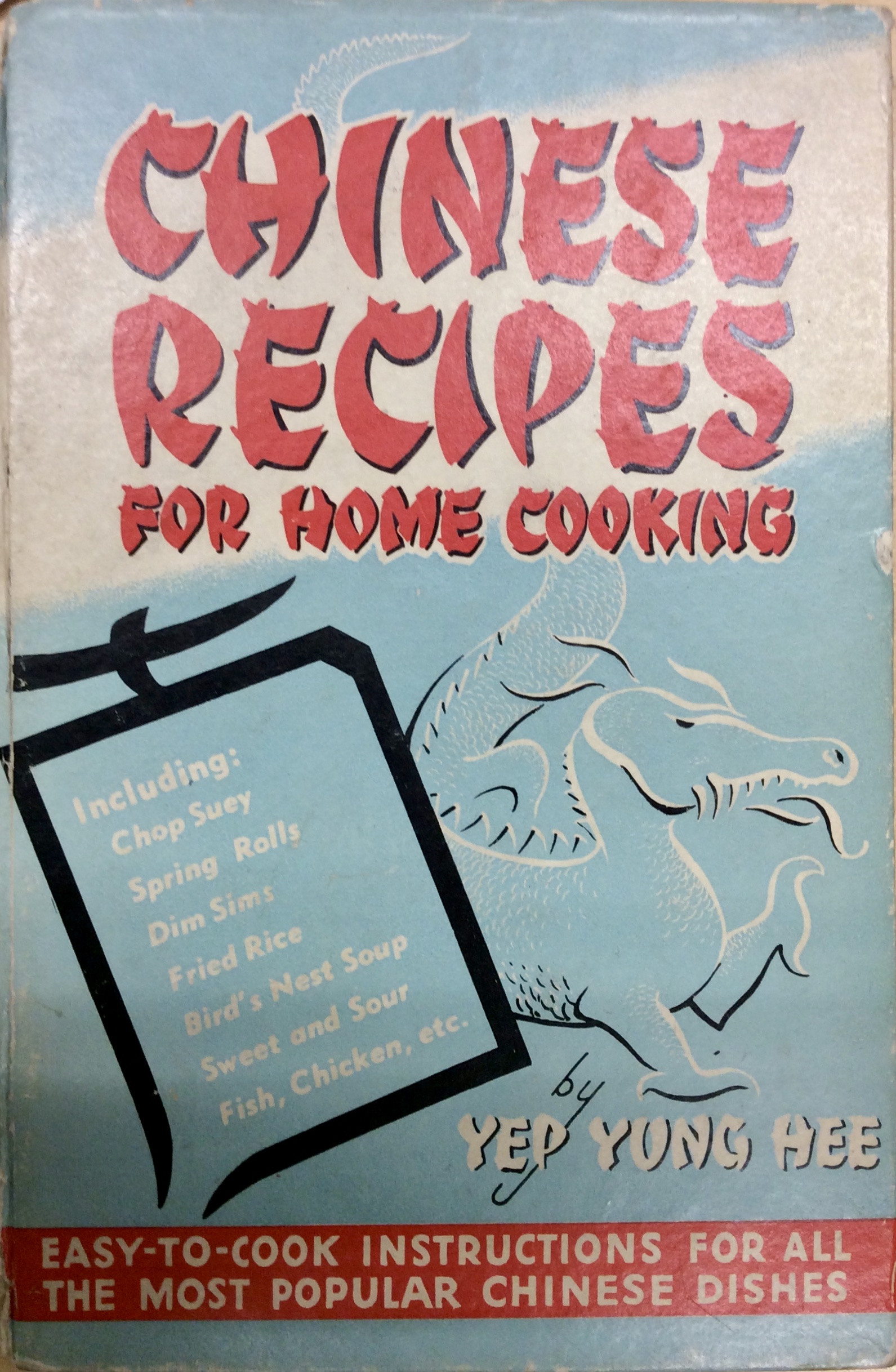
Chinese Recipes for Home Cooking by Yep Yung Hee, published in 1951, also carried an endorsement from the Chinese Consul-General proffering hope that this book might foster ‘both an appreciation of Chinese cookery and of the ancient traditions of China’.[2] “Yep Yung Hee” was the nom- de-plume of Alwyn Darley Tet Ting Quoy, born in Sydney 1916, and a member of the well- known Quoy merchant family.[3] His compilation ran to several editions and remained in print until the late 1960s.


The last of the early publications was Chinese Culinary in Plain English, by William Sou San.[4] Sou San was born in Cairns 1901, the eldest of a large family. At the time he published his first book he was a merchant at 253 Wickham Street, Brisbane selling a variety of imported products including all the requisites for cooking – ingredients, kitchen tools and crockery. Probably self-published and intended largely a promotion for his business, Chinese Culinary was sold at his shop and through those businesses he supplied. There is evidence that first edition was available in 1950, and a second translation was published in 1965. [5] Of the four authors Sou San is perhaps the least well known but his books are particularly interesting.


        What can these books tell us about Chinese food in Australia? And more importantly what they can tell us about Chinese food in Australia at a significant time in our culinary history - when Chinese cooks have already been active here for the best part of 100 years, but our food culture is yet to encounter other Asian cuisines or indeed Chinese food other than that brought here by the people from the Pearl River delta. Chinese restaurants are just about to really explode in the suburbs and eating out in general is becoming more popular. These books are important both because of their place in the history of English language Chinese cookbooks and because they give the best glimpse of how Chinese immigrants had adapted their foodways to take account of local conditions and produce an Australian version of Chinese cuisine.


        Perhaps the first and most obvious point to make is that these recipes are Australianised simply by being written down. What is generally recognised as the first English language Chinese recipe book was published in Detroit in 1911[6]but English language books devoted to Chinese recipes were still few and far between in the late 1940s, possibly less than 100 and these available mainly in the United States, which makes these early Australian publications all the more important.[7] The main barrier to publication was the difficulty of translating Chinese cooking for non-Chinese cooks.


Traditionally Chinese cooks did not have written recipes with directions that stipulated cooking temperatures, times, and quantities of ingredients. As one writer put it ‘[r]ecipes descended like heirlooms from one generation of cooks to another’.[8] Chinese cooks, whether professionally trained or self-taught, learnt by watching, listening, tasting, and smelling.[9] Apart from the obvious language barrier, there was no common culinary vocabulary. Early English language recipe compilations did not follow any standard transcription of the names for ingredients or dishes – sweet and sour pork could be called sweet and pungent pork, or simply fried pork with pineapple sauce, pineapple chicken was also common in contemporaneous recipe books and may or may not have included vinegar. The term ‘stir-fry’, to describe the process of quick frying cut up material with wet seasoning, over high heat with minimal oil and constant stirring, was not coined until 1945 (in Buwei Yang Chao, How to cook and eat in Chinese, New York: John Day). 

Language barriers led to misunderstandings and Australianisms. Sou San explains that the terms Long Soup, for soup with noodles, and Short Soup, for soup with dumplings, arose because Chinese restaurateurs struggled with how to interpret their names for these dishes to their customers, and of course vice versa:

In many cases the illiteracy of the proprietor prevented him from interpreting his menu, hence the birth of Long and Short Soup. The former is egg noodles, and the latter is minced pork and prawns wrapped in pastry, boiled and served in chicken soup.  [10]

Similarly, Yep Yung Hee explains that what passes for dim sims in Australia are called shiu mie by the Chinese and that dim sim is not the correct name for any particular type of pastry, although he admits that Australian born Chinese, including himself, refer to shiu mie as Dim Sims.[11]

Australian born, Geechoun, Sou San and Quoy had, in the main, learnt about what constituted Chinese food from watching, listening, tasting, and smelling in Australian kitchens.[12] Their experience of Chinese food was largely Australian Chinese food, so that their own tastes and the food they prepared for themselves were already ‘Australianized’. None of these authors were trained cooks. Alwyn Quoy is the only one who admits to having spent any length of time in China studying food preparation, although many of the observations in Sou San’s books suggest that he had a thorough knowledge of methods and ingredients and probably some experience of cooking.

While we might assume that the main aim of these books was to introduce non-Chinese cooks to the mysteries of Chinese cooking, William Sou San was also concerned that many Australian born Chinese had neither learnt to speak the language of their parents nor taken much interest in cooking their own food. He intended his work would assist those ‘who had a yearn for the food they had so long ago tasted, now almost forgotten’.[13] He was also no doubt aware that many of the Chinese ‘cooks’ who were sponsored to come to Australia and exempted from the dictation test, on the basis of being non-competitive labour, were in reality family members and other young men who had little or no kitchen experience. By the 1950s, the majority of cooks in Chinese restaurants, whether Australian-born or not, had likely learnt to cook from their elders in Australia, who in turn were reconstructing the food they remembered from home using what was available to them here.[14] Sou San’s book is significant in that it gives us a unique glimpse of not just the flavours that Australian Chinese yearned for, but also a record of what Chinese restaurants may have served to both their Chinese and non-Chinese customers. 


                    Daily Telegraph (Sydney), 11 September 1952, p. 18


All the authors admit that some substitution or compromise when it comes to ingredients is inevitable but insist that the end result is no less ‘Chinese’. The use of sherry or brandy instead of Chinese rice wine for example is common (which suggests that it may not have been available here). Others, such as the suggestion silver beet is a substitute for Chinese cabbage, or essence of anchovies might be an alternative to oyster sauce are not so much concessions to Australian tastes as acknowledging the availability of specific ingredients outside the shops in Chinatown.

Sou San claims that Chinese noodles were unknown in Australia before WW1 and spaghetti was sometimes suggested as an alternative until manufactured noodles became available in Chinese stores. Yep Yung Hee provides a compromise recipe for Pork with Broccoli and spaghetti – stir fried pork and broccoli in a sauce flavoured with soy sauce, ginger and garlic, served over lightly fried cooked spaghetti which is a fully Australianised version of chow mein.[15]

Perhaps the most adventurous use of available vegetables is Sou San’s Veal and Brussel Sprouts of which he says: ‘Brussel sprouts are sensitive vegetable’ and cautions never cook more than time specified, otherwise outcome 'disagreeable flavour’.[16] Similarly he warns never to overcook cauliflower or ‘a sloppy taste occurs’.[17] Sou San also hints at other issues Chinese cooks faced in making dishes the way they might have preferred when he notes that ‘Spare-ribs in Australia the butchers as a rule do not sell as it goes with pork-chops’ but ribs could be obtained through a direct approach to the butcher.[18]

Recipes for dishes using beef or lamb are more obvious examples of Australian-Chinese developing new tastes. Sou San claims that his beef dishes were not know in China when his forefathers came to Australia and so they developed them here, echoed by Yep Yung Hee who claims that beef was not normally eaten because the taste and odour are too strong.[19] Both comments point to the Cantonese ancestry of most Australian Chinese at this time and perhaps also to the state of Chinese agriculture when the gold rush Chinese migrated here.

For the most part the recipes provided by these authors are quite simple – they use a minimum number of ingredients and rely on subtle flavours, and of course the technique of stir frying. The purpose of these books was to demystify Chinese cooking and overcome suspicions and prejudices, not just about cooking in the home but eating in Chinese restaurants. This meant a balance between maintaining the mystique of the exotic and recipes that were approachable. For example, there are recipes for bird’s nest soup but not for chicken feet, nor much mention of offal which was fast disappearing from Australian kitchens. Before these books were published recipes for Chinese dishes had appeared sporadically in Australian newspapers, magazines and in other cookbooks and so ideas of what constituted both typical Chinese dishes and those that Westerners might be interested in – like chicken with almonds, fried rice, chop suey, eggs foo yung, and sweet and sour pork - were already well established.

The use of supposedly ‘non-Chinese ingredients’, such as tomato sauce and tinned pineapple in sweet and sour, are often conjured as examples of concessions to western sensibilities. Pineapple however was an established commercial crop in the east by the end of the nineteenth century and Jessie Norton’s Chop Suey cookbook from 1911 included a recipe for chop suey specifying a can of imported Chinese pineapple, which she described as ‘very fine in flavor’.[20] The adoption of tomato sauce and Worcestershire sauce is perhaps not so surprising since these products are themselves based on borrowings from the east. To imagine that Chinese food was somehow unchanging is to deny the fact that Chinese dishes had evolved over centuries through contact with non-Chinese sources absorbing both ingredients and methods of cooking. And of course it wasn’t just Chinese food that adapted to Australian conditions but pretty soon Australian food became ‘Chinesified’, to the extent that the Australian Women’s Weekly sanctioned the inclusion of soy sauce in the great Australian meat pie.

Chinese restaurant food has been much maligned as a bastardised version contrived to suit western tastes and bearing little relation to the food Chinese eat themselves. These books give us a glimpse of how Chinese Australians were able to sustain their food culture and adapt to their circumstances by shaping their own tastes. William Sou San believed that ‘half the interest of experimenting with Chinese cooking lies in adapting to your own judgement and its needs and taste’.[21] Roy Geechoun assured his readers that while the Chinese abroad may not always have all the ingredients he is used to, he still ‘manages to stick pretty closely to his national dishes’. Through adapting, he claimed ‘very tasty dishes can still be prepared with whatever foods are available, cooked in the Chinese way’ and overtime ‘these adaptations will be looked upon as true Chinese dishes’.[22]


[1] Roy Geechoun (1948), Cooking the Chinese Way, Melbourne: W. D. Joynt.

[2] Yep Yung Hee (1951), Chinese Recipes for Home Cooking, Sydney: Associated General Publications. Revised and enlarged (from 95 to 144 pages) in 1953 to include introduction covering Chinese customs, table etiquette, table setting, food service, conduct of banquets, role of food in celebrations, tools used in Chinese kitchen; Yep Yung Hee (1953), Chinese Recipes for Home Cooking, 2nd ed., Sydney: Horwitz. Reprinted annually from 1955 until 1963, then 1965, 1967 and ‘deluxe edition’ 1968

[3] See entry for Yip No Hung in Australian Dictionary of Biography https://adb.anu.edu.au/biography/yip-ho-nung-12087. Quoy served in the Airforce in World War II and received the OAM in 1997 for services to the community as foundation president of the Kittyhawk Squadron branch of the Royal Australian Airforce Association for over 40 years, and president of the 77 Squadron Association.

[4] William Sou San (1952), Chinese Culinary in Plain English, Brisbane: W. R. Smith and Patterson; William Sou San (1965), Chinese Culinary in Plain English, 2nd trans., Brisbane.

[5] First advertised Courier Mail (Brisbane), 13 October 1950, p. 4. Revised and enlarged (104 pages) 1952, ‘second translation’ (216 pages, completely rewritten). Details of Chinese ingredients, glossary with Chinese names, advice on utensils and how to eat. Richard Beckett (1984), Convicted Tastes: Food in Australia, Sydney: George Allen & Unwin, p. 164, ‘This engaging work sold as far as I know only in Chinatowns in various cities’

[6] Jessie Louise Norton (of the Chicago Inter-Ocean) (1911), Chinese cookery in the home kitchen, being recipes for the preparation of the most popular Chinese dishes at home, Detroit, Mich.; Chino-American Publishing Company.

[7] See Jacqueline M. Newman collection www.flavorandfortune.com.

[8] Sara Bosse and Onoto Watanna (1914) Chinese and Japanese cook book, Chicago: Rand McNally and Company.

[9] Anne Mendelson (2016), Chow Chop Suey: Food and the Chinese American Journey, New York, Columbia University Press, pp. 104-5.

[10] Sou San (1965), p. 157. See also Julia Robinson https://slll.cass.anu.edu.au/sites/default/files/andc/DICT_OZWORDS_OCT2015.pdf, suggests misunderstanding on part of customers.

[11] Yep Yung Hee suggests the term originates from the Cantonese dimsum which refers to an assortment of pies, buns and snacks served at the ‘Heart of the hour’. (1951, p.  40; 1953, pp. 73–74).

[12] Geechoun on the other hand worked with a chef to put together the recipes for his book and ensure that quantities of ingredients and cooking times were accurate. Geechoun (1948), p. 2).

[13] Sou San (1952), p. 11.

[14] Barbara Nicol (2012) ‘The Breath of the Wok: Melbourne’s Early Chinese Restaurants’, unpublished PhD thesis, University of Melbourne, p. 263.

[15] Yep Yung Hee (1953), p. 98.

[16] Yep Yung Hee (1952), p. 67.

[17] Yep Yung Hee (1952), p. 22.

[18] Sou San (1952), p. 43.

[19] Sou San (1952), p. 37; Yep Yung Hee (1951), p. 68; (1953), pp. 112.,113; Geechoun (1954), pp. 35, 37, 38, 43, 45.

[20] See also Mendelson p. 121, re. canned pineapple.

[21] Sou San (1965), p. 12.

[22] Geechoun (1954), pp. 5,6.