Tuesday, March 31, 2015

'Australian gustatory memories' in Focus


The 'Alimentary' column in Focus began with contributions from Oscar Mendelsohn's circle of friends which tended to limit its scope. Mendelsohn hoped that his journal would 'help raise eating in Australia to its rightful place as a fine art', his contention being that satisfying the senses of taste and smell was as important as satisfying those of sight and hearing. To that end he encouraged submissions from readers on eating facilities in all and any Australian cities and 'notes on food and beverages generally', assuring would-be contributors that 'we are willing to print reviews on new lines of foods and drinks as cheerfully as those of plays and books'. (Focus August 1946)

Not all his readers were as enthusiastic about the notion of raising eating to a fine art. In September 1947 Mendelsohn published a letter from 'B.C' of Milson's Point, Sydney under the heading of 'Alimentary Fan Mail',
Alimentation - phooey! I belong to the C.B.C. (Corned Beef and Carrots) cult. (Can you beat the dish, mother's masterpiece on washing day?) Candidly, Focus is generating a tribe of food fanatics. There is a nitwit element in mankind which refuses to learn the rudiments of alimentation, and flits from dish to dish in the hope of finding an elixir.
What poor old B.C. would make of our current fascination with food we can only try to imagine. However, he needn't have been too concerned that things would change in Australia any time soon.

For the September 1946 edition 'Pot' contributed another piece for the 'Alimentary' column entitled 'Australian Gustatory Memories'. Here he lamented that, although the Italian and Chinese restaurants were all 'reliable and artistic', they actually meant little in the grand scheme of things.
They have catered only to a small stratum of the community - mainly the artists and other intellectuals who have sensibly elected to carry their good living to the stomach as well as the mind - together with a still smaller section of the arty, to whom such places are mildly interesting; also, they have retained all their native character and are in no sense Australian.
According to 'Pot' breakfast was the best meal to be had in Australia, even allowing for 'the dreadful and atrociously expensive manufactured and depreciated cereals' copied from the US, the grey coffee and the 'leathery' fried eggs. He extolled 'the simple combination of a grilled steak with an egg coyly perched on it' as 'one of the few Australian culinary inventions'.
When the steak is  really grilled and not deep-fried and the egg is poached or lightly fried on both sides, and if there are some piping hot, crisp chipped potatoes on the plate, a good start of the day is assured.
He also suggested that a really good breakfast would include a selection of properly chilled fruit juices.

For lunch, 'Pot' praised the culinary inventiveness of the 'double-cut roll' which he attributed to Adelaide. This was a variant on the American triple decker sandwich, but in Adelaide, where he believed Australia's best bakeries were to be found, the fillings were of better quality and more varied than elsewhere. Most sandwiches, he implies, made use of some variation on 'flabby Kraft cheese' and 'dry, dark-hued corned beef'.

Alas steak, eggs and chips and well prepared sandwiches do not make an Australian cuisine.

Aside from one or two memorable meals, all of them pre-war, Pot had little to say in praise of Australian cooking. In general there seemed to be a lack of respect for freshness and precious little inventiveness. When it came to crayfish for example the Americans grilled them, and produced chowders or fried them in butter but the best Australia could do was a curried version which he described as 'dreadful'. Similarly in most places in Australia roast beef was 'respectable enough' but 'rather dull' when all it needed was 'the intelligent use of herbs' to make it into something much more interesting. And this from a man whose favourite breakfast was a well prepared steak, a non-leathery egg and crisp chips!

 Two things should be noted about Pot's remarks. Firstly, he was talking about food served outside the home, so we shouldn't assume that 'B.C' and other members of the Corned Beef and Carrots cult were necessarily averse to, or unfamiliar with, the use of chives and lemon thyme and rosemary as Pot suggests. And the meals he praises are all remembered from a time before there were any war time restrictions , when oatmeal porridge could be eaten with unlimited amounts of thick cream.

None the less, these themes - lack of any cuisine that could really be called Australian; lack of respect for freshness despite a preponderance of good ingredients;  simple, unadorned food that could best be described as 'dull';  a readiness to adopt manufactured and 'depreciated' products; and a general disinterestedness in the notion of eating as a 'fine art' - all raise their heads again the best part of forty years later in Michael Symons' One Continuous Picnic. But it's hard not to have a bit of sympathy for B.C and his CBC brigade. There really isn't anything wrong with a good piece of corned beef, carrots, peas, mashed potato, some white sauce, or maybe even some cauliflower cheese. Today we would call this 'comfort food', to turn to when we are tired of flirting from one new dish to the next. The secret of these 'dull' meals is all in the quality of the ingredients and, most importantly, the care of the cook. Perhaps we should consider that B.C's mother really did have the skill to produce a masterpiece on washing day.


Thursday, March 12, 2015

'Focus' on food in Sydney

After Pot's review of the Melbourne restaurant scene, Focus turned its attention to eating in Sydney for the 'Alimentary' column in the next edition, July 1946. In this instance the writer was Minka Veal. Minka was the Australian born daughter of Russian-Jewish parents who had established a clothing factory in Flinders Lane - A. Wolman Pty Ltd.  Minka began her working life in the clothing factory but the business foundered during the depression which meant she had to find an alternative living. In 1937 she opened the Café Petrushka  with Jessie Sumner. Here they served Russian tea in delicate glasses and a menu of Russian specialties such as borscht, cabbage rolls and halva. Although the café closed in 1939, during its brief life it was a popular haunt of theatrical celebrities, journalists, artists and writers, the likes of Albert Tucker, Max Meldrum, Alan Marshall and Hayward Veal. Minka and Hayward were married in 1944 and left Australia in 1951. (You can read more about Hayward Veal here.)

While she only wrote this one column for Focus before the magazine folded, Minka Veal was perhaps the first female restaurant critic in Australia. With some minimal qualifications to judge other eating establishments Minka nonetheless saw Sydney through the eyes of a Melbournian. Fortunately there was some good news, since new licensing laws had been introduced in New South Wales. Although the regulations were still quite restrictive, restaurants in Sydney can now be licensed to serve wine with a meal of not less than two-courses between noon and 2 p.m. and again from 6 p.m. to 8.30 p.m. provided that all bottles and glasses had been removed from the tables by 9 p.m. Even so Minka describes Sydney as 'a city which probably has, on the whole, the worst collection of eating places for any city of its size'. The only places which remain open at night (that is after 8 p.m.) are the Repins cafes and the Monterey, where the service is good 'but the best they can offer a hungry diner is something on toast'.

Vere Mathews restaurant, in King Street, has been taken over by Tom Hills, who has made some changes. Notably the staff are now gracious and smile, they don't interrupt diners' conversations and they have learnt to present the bill face down. All of which Minka implies make the place much more civilised although she has nothing to say about the quality of the food.

Mockbell's coffee shops have a colourful history of their own which I will write about at a later date. By 1946 however Mockbell's was not to Minka's taste. She calls it 'one of the worst cafes in Sydney', 'everything about it is appalling', with its stifling atmosphere and outdated decor. Although she does grudgingly list the best things to eat there - lamb's fry, devilled kidneys, grilled chops and chicken sandwiches.

The Oriana Café in King's Cross was much more her style. With a large inside room and an open-air area 'near enough to be called a pavement cafe', the Oriana also boasted a talented pianist as well as good food, in particular their apricot cake.

Rainaud's and Prunier's were both laudable. At Prunier's in particular everything was 'tops', the meat tender, the claret 'just right', the selection of Continental dishes 'excellent' and the three rooms 'furnished in simple good taste'. At Gleneagles however she had been served 'grilled steak and roast chicken ...  which my husband certainly wouldn't eat if I served it to him at home'.

She also lavished praise on Kanimbla. Always crowded Kanimbla offered excellent value for money and a good range of dishes, huge T bone steaks and tender juicy roast duck and chicken. The 'sourcrout' here also rated highly - 'just like my mother used to make'. Plainly furnished this was' not the sort of place to linger in' but attracted clients who took their food seriously.

The Florentino, in Elizabeth Street, was popular with university students (and priests, according to Minka) since it offered a cheap meal but the food was not good. Minka found the soup was never served hot enough and there was never enough sauce on the spaghetti. Margaret Fulton also frequented the Florentino, which she says was popular with 'fringe bohemians and the impecunious'. She describes the restaurant as like a private club, a different world where 'journalists, artists and other bohemian riffraff were at ease'.

Rainauld's had been established for many years by the time Minka dined there. I am uncertain who owned Prunier's in June 1946. According to Ted Moloney, Tony Geminis opened Pruniers on 1 April 1947, but he may have taken over an established restaurant? Nonetheless Moloney considered Pruniers was still 'the place to go' in 1967 (Sun Herald 23 July) and Tony Geminis was still in charge, and the restaurant's reputation still intact, when Leo Schofield wrote about it again in 1988 (Sydney Morning Herald 17 May). Sadly there is no general history of the restaurant scene in Sydney so the details of many of these restaurants is at best sketchy.

For Minka the Chinese eating places could not compare to Melbourne.
Although I know their vegetable delicacies are unobtainable now, I cannot become accustomed to finding large quantities of sliced carrots and cauliflower in my Chinese dishes. The best of a bad lot, I think, are the Shanghai, the Modern China, the Tien Tsin and the Nankin.
The Hong Kong was the most European of the lot with salt, pepper and sugar on every table. According to Minka 'the personnel in the place seems to be the most Chinese part of it'.

And so ends her first and it seems last foray into restaurant criticism. Minka and Hayward left Australia not long after this and did not return until 1968. It would be interesting to know what she thought of Sydney's restaurants twenty some years later.


Fulton, Margaret 1999, I sang for my supper, Lansdowne, Sydney.


Friday, February 20, 2015

'Focus' on food in Melbourne

Oscar Mendelsohn is often referred to as a 'polymath', which essentially means that he is one of those people who managed to pack so much into one life that reading about them is exhausting.
Trained as a chemist he ran an analytical laboratory in Melbourne and was a great advocate of civilised dining but for a much more comprehensive account of all his interests and achievements see the entry in the Australian Dictionary of Biography here
.
During the 1960s he published a number of books which reflect his interest in food and drinking - such as From cellar and kitchen, A salute to onions: some reflections on cookery and cooks, A dictionary of drinks and drinking - and was a regular contributor to Epicurean magazine- 'a journal dedicated to the appreciation of the finer things' and the first Australian magazine devoted entirely to food and wine.

In the late 1940s Mendelsohn edited a short-lived journal called Australian Focus Monthly or just Focus. I am a bit hazy on the exact details of this publication. A journal called View, a journal of opinion  ran for four editions from February 1946 (volume 1, number 1) to May 1946 and then became Focus, the Australian journal of opinion for two editions, June (volume 1, number 5) and July 1946. The first edition under the title Focus Monthly was August 1946 (volume 1, number 7). Focus appears to have ceased publication with the edition for September 1948. In this journal Mendelsohn addressed the issues of interest to him with the aim of providing  his readers with a publication 'catering for intellectuals and presenting a point of view unbiased by party political prejudices or powerful sectional interests'.

The first Focus (June 1946) introduced a column called 'Alimentary'. Over the years this was authored by a variety of people and covered a range of topics. What interests me are the restaurant reviews.
The first 'Alimentary' was titled 'Eating in Melbourne' and began
As befits the second-largest Australian city with the worst climate, the drabbest architecture and the most wowsery controls, there has to be compensation somewhere, and Melbournites find one avenue of it in restaurants. There can be little doubt that the eating places of Melbourne are the best in Australia. By best I mean, of course, in quality of food. And to be good they have to be very much so - good in spite of the dearth of wine licenses and the puritanical prevention of anything that might tend to mitigate the effects of the winter, ten years of Country Party rule and the edicts of the Housewives' Association. ... For good cooking at reasonable prices, Melbourne is far ahead of every other Australian capital, and indeed, for food alone, not noticeably below civilised European and American standards.
The author of this paean to Melbourne signed himself 'Pot'. The editor describes 'Pot' as 'a regular contributor' who may have been L. L. Politzer.  Politzer was a writer and translator, originally from Munich, who wrote for 'Alimentary' under his own name in later editions (February 1947, September 1947).

Pot wrote enthusiastically about the Italian and Chinese restaurants in Melbourne. His Italian favourite was the Society Restaurant, 'a  pleasant place' where 'the minestrone and the spaghetti are always reliable'. The best value for money in Australia however was to be found at Nello Borghesi's Hoddle Restaurant in Collins Street. The San Lina, in Exhibition Street, is 'cheerless' but 'satisfactory'. Although not the place it had been, the Florentino remained 'steadily good' somewhere to be relied upon for 'civilised food and deft service'. Mario's also rated a mention as 'much improved'.

Pot's articles mention some of the changes in the restaurant culture wrought be the war years.  The Italian Society Restaurant had changed its name to simply the Society as 'a wartime concession', and Mario's had thrown off 'the hectic, pseudo-naughty atmosphere, and the rather arrogant attitude of the U.S. Army days'. The war years had meant austerity both in the home and in restaurants with controls on prices and a shortage of ingredients and of suitable staff. Some restaurants chose to close altogether. On the plus side war work brought many more civilian workers into the city and the arrival of American troops (in 1942 and 1943), who came with money in their pockets, meant even more mouths to feed and a reasonably prosperous time for some restaurants and cafes. Menus were often changed to accommodate the American's palates. As Pot's comments suggest their presence may not have always been to the good but their fondness for Chinese restaurants in particular is credited with being a milestone in the popularising of Chinese cuisine in Australia.

For the servicemen a Chinese restaurant was somewhere  cheap, a source of familiar food for many and particularly attractive because most were open late into the evening and open on Sundays.
Pot found the Chinese places, of which 'there are dozens, both in the city and in the suburbs', all 'reasonably satisfactory' although the best are 'outwardly repulsive or off the beaten track'.
In truth, you cannot go seriously wrong in any Melbourne Chinese place, provided it is not equipped with a radio or other obvious European improvement.
Although standards were down because of the difficulty of obtaining imported ingredients he could still recommend the Dim Sims, Bor Lor Kie and the Kie Sie Min. The Tien Tsin he claims as 'one of the best outfits of its kind in Australia' but his top choice is 'that repulsive dump, the Chung Wah'.

Other places Pot noted include the Melbourne Oyster Saloon for seafood, the 'solid, unpretentious, inexpensive' fare at Kanis (both of which he  later classifies as 'hearty, essentially masculine places', of which Melbourne has too few), the superb food (although perhaps not the floor show) at Claridge's, and the Riverside Inn where they were 'making a brave and commendable effort to provide fine food under civilised conditions' although he feared it would become very expensive once the war time controls on prices were removed. He was also able to recommend a handful of places in 'the two-bob and  under class' providing hearty meals. The meals at Melbourne hotels however were undistinguished and 'no better than they ought to be'.

By November 1946 the restraints of the war years were being cast off.
Many of the most interesting and civilised of the restaurants have been expanding, spring-cleaning, furnishing, re-allocating and generally showing a determined effort to consider the interests of customers.
Whilst there was still no question of 'the present superiority of Melbourne restaurants over those in Sydney', Sydney had taken 'a real advance towards a grown-up attitude to life' by introducing new liquor licensing laws making it possible for restaurants to serve light alcoholic beverages.
Staff numbers were returning to normal, more tables were available and the 'soddening influence' of the Americans was fading so that the diner could now expect to be greeted with 'smiles, good humour and an evident desire to please'.

Most of the places which closed during the war (usually restaurants attached to hotels) have reopened. The Society has opened a new upper floor, the standards at the Florentino remain high,  the Latin continues its 'good-natured service', and Molina's has come back to life setting 'a standard in the intimate, family type restaurant in the best Continental tradition' (although the meal he describes - antipasto, scalloped oysters, fried chicken, chunky fillet mignon and a rum omelette sounds unremarkable and not particularly 'continental'). Change has not however been all to the good. The Ritz in Lonsdale Street has been taken over by an Australian and now offers 'a drab menu of commonplace cooking'  reflecting a lamentable decline in standard.

Pot returned to the Melbourne restaurant scene in April 1948. All is still well, the standard of food and service continuing to improve but 'Mediterranean cooking, especially that of Italy, has almost monopolised the upper strata of Melbourne'.
Admiration though I have for the Italian alimentaria, I still regret the sameness that is creeping over our Melbourne eating houses. The pasta may be a little better here, the antipasto there, and so on, but these differences are not extreme. What one does miss in Melbourne is true variety.
Despite the Chinese restaurants and the Greek 'steak-a-d'oysts (quite Australian and extremely useful)', the afore mentioned Mediterranean places and the 'characterless' international fare to be had at the big hotels Pot felt that there should be more. Why no Scandinavian, or German or other Central European restaurants, and why not 'a first-class Indian establishment'?

Tired of Italian conformity Pot rated the Occidental Hotel in Collins Street as the best place to eat in Melbourne. Expensive yes, but good value. A close second was the London Hotel where the meal 'must be unsurpassed in the world to-day for value' - soup, fish, entree, poultry, sweets, coffee and salad could be had for an outlay of only 5/-.

Thirty years on much had changed of course although not perhaps the rivalry between Sydney and Melbourne. When Peter Smark compiled his Eating Out in Melbourne 1977 he did include one restaurant where the food was' basically Scandinavian' and one where the food was classified as 'Bavarian' out of a total of 125. In addition three Indian restaurants and three serving Hungarian food were also considered worthy of inclusion. The five Greek restaurants listed had moved beyond steak and oysters. Smark's selection also included 17 French restaurants, 18 Italian and eight classified as Cantonese. The biggest group, 42, fell into the catch-all of 'International'. Whilst it might still be true that the Italian restaurants had a certain sameness about them there can be no dispute that Melbourne no longer lacked the variety to satisfy even a demanding critic like Pot.

To read more about the development of the restaurant scene in Melbourne see Charmaine O'Brien's Flavours of Melbourne. A culinary biography (Wakefield Press, 2008). The influence of American serviceman on the popularity of Chinese restaurants in Melbourne is covered by Barbara Nichol here.

Monday, February 2, 2015

The fascination of Fasoli's

 Louis Esson immortalised Fasoli's in this poem which was first published in the Bulletin in 1906.

The Temple of Bohemia, it boasts no golden gate
It flaunts no marble corridor to lure folk to their fate;
But down the pavements dreary, towards one dim lamp's glow,
Fasoli's draws the pilgrims where the good Bohemians go.

Oh! that bottle-laden table! Oh! the mixed and merry scenes!
And oil and garlic mingled with that salami and beans!
Fat macaroni festoons, and pungent, ruddy wines -
Oh! 'tis Bacchus waves his thyrsus where the Latin Quarter dines.

The world is spun of patchwork; and some there are belong
To prayer and holy living, and some to dance and song;
And some explore the cloister to find the key to Truth - 
But some prefer the wine-shop and the commonwealth of Youth.

Italian, Swiss and German, French, Chilian and Russ
They fraternise with Cockney, and with Yid and Yank and Us.
They've humped their swags from God knows where, the whirling wide world round,
But in old Fasoli's wineshop they meet on common ground.

And there's rich and poor all talking in the tongues of all the earth;
There's dominoes and piquet, and there's long-resounding mirth;
There's every brand of rover making merry at the bar,
And there's smoke, and wine, and strumming of the harp and gay guitar.

All the creed and caste are buried; there's only man to man -
A strange Australian picture of the Cosmopolitan.
And there's no bad blood among them, though their arguments may roll
From the price of beer in China to the future of the soul.

The world is spun of patchwork, and some there are belong
To prayer and holy living, and some to dance and song;
A rocky road to Heaven, a sloping path to Hell - 
But which road is the right one? ... Good God, it's hard to tell!

The Temple of Bohemia, it boasts no golden gate,
It flaunts no marble corridor to lure folk to their fate;
But song and mirth and mateship; ah, well, 'tis wise to know
That wine-splashed road of Bacchus that the good Bohemians go.

No history of dining in Melbourne, indeed no history of dining in Australia seems to be complete without a mention of Fasoli's. But Fasoli's fame rests, as Esson's poem suggests, not on the food served there but on the atmosphere of the place and the people who met there. The story of Fasoli's also taps into the wider story of Italian immigration and the influence Italians have had on the dining culture in Australia.

The establishment at 110 Lonsdale Street which Vincent or Vicenzo Fasoli took over in 1897 had originally been established as the 'Pension Suisse' as early as 1864. Abraham Gascard, the first owner, appears to have run the place as a lodging house (in the Argus 2 April 1865 p. 5 he is described as a 'lodging house keeper , Lonsdale Street') but also advertised 'Gascard's genuine colonial wines' which could be purchase for 1s a bottle or 4d a tumbler at 135 Bourke Street east (Argus, 7 November 1866, p.8). Gascard and his brother Jules appear to have been keen businessmen and associated with wine making and wine makers in the Rutherglen area. In a letter to the Argus (25 August 1870) Abraham Gascard describes himself as 'one of the oldest retailers of colonial wine'.

In 1868 the 'Pension Suisse and Colonial Wine Shop' passed into the hands of another Swiss, Colestin (or Coelestine/Celestine) Frey. Frey had been making wines on Sutherlands Creek outside Geelong and remained in Lonsdale Street until 1882. There were several other licensees in the ensuing years, Carlo Brocco 1883/1884, Monigatti, Fedelle and Co. 1885, Imhoff (Charles) and Co. (Imhoff was a member of the Swiss Society of Victoria) 1886 - 1888, Carlo Pescia 1890 - 1893, Angelo Piezzi 1893 - 1896 (Piezzi had previously held the license for the Colonial wine hall at 57 Exhibition Street) and finally Valentino Franzone who took over from Piezzi in 1896 and then handed over to Fasoli in 1897. Franzone went on to run an Oyster Saloon, advertised as a first-class restaurant charging 3d a course at 399 Sydney Road, Brunswick.
Although the exact lines of connection are unclear all these men had contacts with their fellow country men who were making wines locally and their wine hall operated as an outlet for this local production.

Born in Nobbialo, on the north western shore of Lake Como,Vincent/Vincenzo Fasoli was in his early twenties when he arrived in Victoria in 1864, coincidentally the year the 'Pension Suisse' was established. Why he came to Melbourne is unknown but it is likely he already had some contacts here because he seems to have made his way straight to the Italian community which had established itself around the Jim Crow diggings in the Daylesford area.

In 1868 he marries Bridget White (who is Irish), and they have five children, four daughters Milly (Amelia, 1869), Kate (1870), Mary(1872) and Virginia (Florinda, 1874) and one son, Nicholas (1878), all born in the Daylesford area. Just what Vincent did with himself in Daylesford isn't entirely clear although it appears that he tried his hand at wine making. By1869 V. Fasoli and Co. have taken over an established vineyard at Spring Creek and Fasoli is winning prizes for his red and white wines at the Glenlyon, Franklin and Daylesford Agricultural Show (Illustrated Australian News for Home Readers, 22 March 1869, p. 67, The Australian 3 April 1869 p. 25).

In 1889 Vincent Fasoli applied to become an Australian citizen, urgently requesting his letter of naturalisation 'for the purpose of obtaining a transfer of a Victualler's License'. On his application he lists his occupation as hospital wardsman. According to J. Alex Allan, Fasoli bought the Carriers Arms Hotel in Daylesford in 1893 ('Bohemia in Melbourne', The Argus, 6 August 1932).

1898 sees the Fasolis in Lonsdale Street, Melbourne. Vincent runs Fasoli's until 1905 when he retires and hands over the management to his daughter Katherine, now married to Nerino Maggia, a surveyor from Genoa who had arrived in Australia in 1903.  In 1907 the Maggias move the business to King Street and the original premises are taken over by a Mr. Camuso/Carmoosa and become popularly known as 'Carmuso's' although eventually renamed 'The Ritz'.

Vincent Fasoli dies in 1919 and his wife Bridget in 1926. In 1929 Kate Maggia also dies and the business passes into the hands of Virginia. (Virginia had married Guido Mazzolini, born in Cremona. Guido arrived in Australia in 1899 and died in 1924.) By 1934 the business was in the hands of Guido Maggia, Kate's son, and is sold, ending 36 years of Fasoli's in Melbourne.

My fascination for Fasoli's involves both its role in the Bohemian life of Melbourne and the story of the Fasoli family. Long before we start talking about the influence of post World War Two migration we have a strong, well established Italian community using their skills and knowledge to make a living and introducing their ways of eating and drinking to the broader community around them. In this case bringing the local wine from Daylesford and the sausage produced there, know as bull-boar, to be enjoyed by the artists, poets, journalists, musicians, parliamentarians and professional men of Melbourne. I am intrigued by the figure of Bridget from County Clare serving red wine and spaghetti to her clients and how clearly her daughters, Kate and Virginia, identified with their Italian heritage, presumably a result of their upbringing in the Italian community of Daylesford. For most of the life of Fasoli's it was not run by Vincent but by his daughter Kate, and it was Kate who maintained the novel menu and the Bohemian atmosphere.

In his reminiscences I Recall, Robert Croll (p. 43)  has this to say of Fasoli's -
Many have written of both the old and the new Fasoli's: none, I think, has done justice to the memory of Mrs. Maggia, under whose firm and beneficent rule it prospered for such a number of years. She was a woman who had to play a tactful and often difficult part, and well she did it. She earned respect and liking; at her death I felt the loss of a personal friend.
Here I found a whole new world of sensations. I was delighted. The salads (particularly the potato salad) and the 'shark' (as any fish was named, from sardines upward), or the salami (believed by all to be of horseflesh) which prefaced the more important dishes; the spaghetti with its grated cheese; the general flavour of oil and garlic; the vin ordinaire (it was proper to refer to this, no matter how excellent it might be, as the etching bath), the novel cheeses (here I first met Gruyere and Gorgonzola) and, above all, the flow and sparkle of talk in many languages - these were indeed a change from the monotony of the normal. Even the fact that you must not part from your knife and fork throughout the meal had a charm - the charm of novelty.
It seems to me important that we don't underestimate the charm of novelty and the important role immigrants to this country have played in teaching us about not just the variety of what there is to eat but importantly how to eat.

The information I've put together here about the Fasoli family has been gleaned from newspapers (available through the National Library Trove search engine), from indexes to births and marriages registered in Victoria and from copies of files pertaining to applications for naturalisation available through the National Archives of Australia web site.


Monday, October 6, 2014

Mrs Rawson, Inventor

Mina Rawson's books are so crammed with useful information and household hints that they make exhausting reading. (See my previous post on her remarkable life here.) She was quite capable of designing her own makeshift oven using 'an ordinary old oil drum' and had endless suggestions for ways of maintaining an orderly household. With her over riding motto being 'a place for everything and everything in its place', she had some very definite ideas about how things should be done.
 In The Antipodean cookery book and kitchen companion (1897) she gives detailed instructions on washing up which involved boiling water in a cut down kerosene tin, which could also accommodate pots, pans and plates, and building a wooden rack which would fit over the wash tub on which soiled dishes and pans could be placed and hot soap suds poured over them. She also advocated a scrubbing brush with a long handle and 'a chain pot-cleaner' which could be fixed on to a handle so that 'the hands need not even be soiled'.
It should not be a surprise then that she invented, and applied for a patent for, an 'Improved labour saving kitchen utensil to be called Mrs Lance Rawson's Kitchen Help'. The Patent's Office were unclear as to whether it was a washing machine, a cooking utensil or a vegetable cleaner but from her description it is clearly intended to be a machine for washing, albeit for smallish 'articles'.
You can see the original patent application, dated 26 September 1898, by searching on the National Archives of Australia web site here.

This is how Mina describes here invention:
My invention is composed of a galvanised iron vessel or billy with a strainer inside revolving on a pivot and connected by  a handle from the outside lid. The vessels are of two sizes fifteen inches and two feet in diameter. The outside vessel has hand rests on each side with three rests inside for the strainer to stand on and an overflow to discharge all water after use. The inside strainer is also of galvanised iron and revolves on a pivot fixed to the bottom of the outside vessel and is worked by a handle from the top. The articles that require cleaning are put in the inside strainer and by turning the handle on the top of the outside vessel enables the boiling water to pass through and over the articles and cleans them without any handling.
She omits to mention that presumably the water has to be fed into the machine somehow and doesn't specify what 'articles' she has in mind to be cleaned. Washing crockery in this apparatus would seem a hazardous business and the inner drum, with a diameter of 38 cm, would only be large enough for small pans, cooking utensils and cutlery. There is no specification for the height of the vessels but if the drawings are to scale the outer vessel stood at around 61 cm with a diameter roughly the same, which means the contraption would take up a fair bit of room in the kitchen.
No doubt Mina had some sort of prototype made but just how effective this gadget was we may never know. I could find no evidence that this idea went any further than the Patents Office. The record states that the patent was not registered. The Brisbane Courier, 10 October 1898, notes only that the registrar of patents did accept the application. However there is an intriguing reference in The Queenslander (10 June 1899). A reply to correspondence received reads 'If you mean a washing-up machine write to Mrs Lance Rawson, Rockhampton who is the inventor' which suggests that the idea may have progressed beyond the drawing board.

Thursday, June 26, 2014

Beating and Mixing

Who would publish a book devoted entirely to eggbeaters?  Well as it happens the same person who has published a book devoted to apple parers. Don Thornton's The Eggbeater Chronicles is a tribute to what he believes is 'America's greatest invention' a claim which he justifies thus
The rotary crank eggbeater revolutionized cooking in America. It took the deadly drudgery out of mixing food ingredients. And that was a big mix, ranging from scrambled eggs, to cream, to batters, to cakes and scores of other deserts, breads sauces.... Mixing became an art - and the variation of eggbeaters vying for attention on the marketplace told a true American success story. (Thornton, p. xiii)
Just how efficient some of the earliest devices were or what they offered in terms of labour and/or time saving  is questionable but there is no doubt that the concept of the eggbeater greatly exercised the minds of American inventors. Thornton's book chronicles the patent and manufacturing history of American eggbeaters from the first patent issued to Ralph Collier in 1856, is full of wonderful photographs and runs to more than 300 pages. According to Thornton over 1000 American patents were granted (up to 1991) and several hundred different mixers were manufactured and marketed.

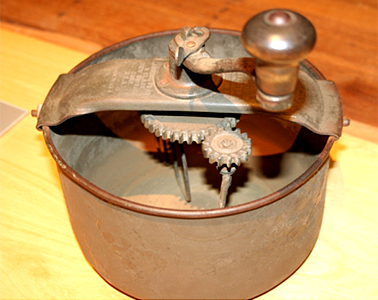
It isn't difficult to understand the enthusiasm for the hand cranked rotary beater at the end of the nineteenth century when the alternatives for beating egg whites to a froth for example were a knife or a three pronged fork  or perhaps two forks held together. Using bundles of twigs was presumably no longer considered an hygienic alternative and for some reason the balloon whisk seems to have been confined to the professional kitchen. A hand cranked, rotary beater still lurks in my kitchen (along with a collection of balloon whisks and a couple of other mixers which look as though they come straight out of Thornton's book) even though, for many applications, hand beating was eclipsed long ago by electrical gadgets of one sort or another. That said however the principle on which my hand cranked eggbeater operates is essentially  the same as that of my Sunbeam Mixmaster, that is
 two revolving beater-frames, said frames occupying the same working space and arranged to revolve in opposite directions so that they may cut against each other with a very peculiar shearing action.... The advantage of having two wheels operating in the same space and revolving in different directions is that the fluid being acted upon is cut and thoroughly beaten almost instantaneously
which is the way the William's Egg Beater was described in the patent application lodged in 1870 (See Thornton, p. 3). It was this patent which became the original 'Dover' beater, the 'Dover' brand going on to be almost synonymous with the egg-beater in the USA.

 American inventors weren't the only ones to be challenged by the concept of the eggbeater and no doubt tempted by the potential financial rewards. At least two Australian patents were issued. In 1899 Robert and Fanny Venus of Launceston, Tasmania patented an 'improved egg-beater and cake-maker' (Patent no. 9796, November 27 1899, as reported in Australian Town and Country Journal, 23 December 1899, p.61) which was subsequently advertised for sale in Launceston with the claim that it would 'make a sponge cake complete in five minutes' (Examiner, 5 January 1901, p. 1). To date I have not unearthed a picture of the Venus invention.

William Valentine Paley and Thomas Henry Bussey of Charters Towers registered the  Paley-Bussey Novelty Chain Egg Beater and Cake Mixer Company Ltd. in January 1904 (The North Queensland Register, 25 January 1904, p. 47). Messes Paley and Bussey had high hopes for their invention and registered patents in Great Britain, Canada, the United States, France, Germany and of course Australia and New Zealand. The Paley-Bussey was a non-mechanical, non-rotary hand held beater which was designed to be spun between the palms of the hands. The inventors claimed that the major advantage of their machine over other designs was the amount of  beater surface in contact with the medium to be beaten. To quote the description in The North Queensland Register (15 August 1904, p. 10) the gadget had a 'peculiar configuration'
the machine has about 9 ft of wire (6½ ft in spring circumference, and 2½ ft in the chains) all working in the stuff right away from the start, whereas with an ordinary whisk there is only (at the outside) about 2 ft of wire working in the stuff, and it is mostly owing to this fact that such excellent results are obtainable.
The other particular feature claimed for this invention was that, because the chains at the bottom hang free, the beater could, to some extent at least, adapt itself to any shape of bowl or dish.
Illustration form Thornton p. 283

However useful this device may have been for beating eggs and despite its name it hardly looks like much of a labour saver when it came to making cakes.

Of all the inventions in Thornton's book the first which really looks like a cake mixer is the 'Universal' Cake-Maker which was patented in 1905.


 Universal cake maker
 Photograph Vesna Ristevski from the collection of Liverpool Regional Museum, Liverpool, Australia.

This was another American invention manufactured by Landers, Fray and Clark of Connecticut. The bowl of the mixer clamped to the bench and the cross piece, with the  'mixing fliers' attached fitted on to the rim of the bowl, held in place with butterfly nuts. The beaters moved when the handle on the top was rotated. The cake maker also came with a 'kneading rod' for making bread and biscuits. Landers, Fray and Clark manufactured 'Universal' brand bread makers, butter churns and mayonnaise makers which worked on similar lines.

'Universal' cake-makers were advertised for sale in Australia from as early as 1907. In 1911 David Jones was exhibiting them in their 'specially fitted Exhibition Rooms' at 20 York Street. Sydney along with 'all the newest inventions in culinary and domestic labour savers' (Sydney Morning Herald, 11 October 1911,  p.5). For the 'Universal' cake-maker it was claimed that it 'mixes the batter for all  kinds of cakes; easier, more uniformly, and quicker than by hand' conveniently omitting to mention that the contraption was in fact still operated by hand.

How popular was the 'Universal'? It looks as though it required just as much elbow grease as hand mixing and from my modern perspective it seems bothersome to set up and difficult to clean. But perhaps if I could take myself back a hundred years I would regard the 'Universal' cake maker with the same reverence that I have for my dear old Mixmaster - which is itself 39 years old this year.

Thornton, Don. The Eggbeater Chronicles. The stirring story of America's greatest invention. 2nd edition. 1999. Published by Don and Diane Thornton, Thornton House Publishing, Sunnyvale, California.
Email info@thorntonhouse.com

Tuesday, May 20, 2014

Keeping it cool

The Ice Cutters by Natalia Goutchanov 
http://www.wikipaintings.org/en/natalia-goncharova/the-ice-cutters

The painting above is the illustration on the cover of my copy of Elizabeth David's Harvest of the Cold Months. The social history of ice and ices (1994), her last work, published after her death. With not a recipe in sight this book is more a series of thoroughly researched essays rather than a comprehensive history of ice and refrigeration but it is wonderful to dip into. She covers an amazing range of sources and there's something fascinating in every chapter (and not always concerned solely with ice).
My purpose for returning to Harvest of the Cold Months was to read up about Italian ice cream but in truth I learnt most of what I wanted to know from Mary Taylor Simeti's Sicilian Food.

The Sicilians and and the Neapolitans were mad for ice using it to cool wine, chill fruit or to make sorbetto  or granita. Taylor Simeti quotes from A Tour through Sicily and Malta written by Patrick Brydone in 1773
The bishop's revenues [the Bishop of Catania] are considerable, and arise principally from the sale of snow and ice not only to the whole island of Sicily, but likewise to Malta, and a great part of Italy, and make a very considerable branch of commerce; for even the peasants in these hot countries regale themselves with ices during the summer heats, and there is no entertainment given by the nobility of which these do not always make a principal part: a famine of snow, they themselves say, would be more grievous than a famine of corn or wine.
Visitors to Sicily in the eighteenth century were very taken by the amount of sugar consumed both in confectionery and ices and as Brydone says ices and ice cream were popular across all levels of society. Apparently most of the ice was collected in March on the slopes of Mount Etna. The snow on the mountain sides was beaten into hard ice with sticks and then rolled down to be stored in caves. The peasantry were the traditional suppliers of ice, the blocks being brought down each day by donkey, wrapped in straw and salt to minimise wastage.
The snow from Mount Etna was plentiful and low in price so that ices could be consumed even by the peasantry and trade in ice was lucrative. According to Elizabeth David  'in the eighteenth century the Bishop of Catania's income had been largely dependent on the £1,000 a year derived from the small patch of mountain reserved for snow for the Knights of Malta'. There was sufficient snow available for four or five hundred tons to be shipped to Malta each fortnight on board the ship maintained by the Knights for just that purpose. I also read somewhere that in 1717 the export of snow provided a twentieth of the municipal income of Palermo. Trade in and enthusiasm for ice was encouraged in the eighteenth century by physicians recommending ice and ice-water for the treatment of fevers.
Palermo's supply of ice usually came from mountains close to home and when the snows failed the matter was taken most seriously. In 1774 a government official was sent off to Mount Etna with an armed guard to bring back snow to relieve the 'universal suffering'.

Sicily of course wasn't the only place which traded in ice and snow, indeed anywhere where ice could be harvested it was made use of in one way or another, and, because of the demand, a considerable amount of time and energy was expended not just on harvesting but on ways of transporting and storing ice and snow. If you ever wondered exactly how ice was harvested Nicola at Edible Geography recently posted a terrific piece about just that. The subsequent story of the commercialisation of ice production and the globalisation of the trade in ice makes for interesting reading. Wikipedia has a good article on the frozen water trade and how it developed in the nineteenth century.

 Before ice was produced commercially in Sydney  it was imported  from Boston which you can read about in the Dictionary of Sydney. [nla.news-article12944577] (Sydney Morning Herald 22 March 1853, p.3)

It isn't hard to imagine how popular ice must have been in the days before home refrigeration and there are certainly many who can still remember the ice man and the domestic  ice chest which preceded the electric refrigerator. There is a photograph of ice being delivered, from the collection at the State Library of New South Wales here [a422009 / ON 225, 22] (Mitchell Library)

The ice chest in the holiday cottage we stayed in when I was a child looked almost exactly like this one which dates from the 1940s here.

The making of sophisticated ices for consumption involved both experimentation with the right balance of solids, sugar and fat, in the mixture to be frozen and with methods for stirring the mixture as it froze to break up the ice crystals and ensure a smooth texture. David mentions milk based sorbetti recipes from the late seventeenth century and milk and custard based sorbetti, involving cream, butter and/or eggs,were certainly  being made in the eighteenth century. Despite all my reading I'm still a bit confused about the difference between sorbetto  and gelato or rather confused about whether there was any historical difference. According to the Oxford Companion to Italian Food
The terminology of the past can be confusing; gelare can mean to set rather than to freeze, and a sorbetto could be a cool drink that was sipped rather than the almost solid mush we know today.
So a sorbetto  might also have meant something which was more like what we would call a granita, courser in texture and slushy, which evolved into today's sorbet, a water ice with a smooth texture while gelato  is a milk or custard base ice. In the end I suppose it doesn't really matter whether all gelati are sorbetti but not all sorbetti are gelati or vice versa. 
Given my previous defense of blancmange I was very chuffed to find this - of Sicilian gelato Taylor Simeti says
Sicilian gelato is not made with cream at all, but with crema rinforzata, which is nothing other than the omnipresent biancomangiare  in a particularly liquid form.
Hurray for biancomangiare.